42% of Employees Now Have a Free Workday — and No Guidance on How to Use It
Forty-two percent of your employees found a spare workday this week, and two-thirds of them didn't know what to do with it. That single BCG number captures something bigger than an AI productivity story: across time, talent, and office policy, leaders are making enormous structural decisions by not deciding — and letting defaults, habits, and even a soccer tournament fill the vacuum instead.
- 🤖 A Free Workday, Unclaimed: BCG finds employees are saving a full day a week with AI — and two-thirds aren't told what to do with it.
- 🧭 The Freelancers Are Already Winning: Skilled freelancing jumped from 28% to 38% of the U.S. workforce in a year.
- 🏟️ The Rule That Broke for a Soccer Match: Goldman Sachs and JPMorgan suspended their return-to-office mandates for World Cup match days.
Read time: 6 minutes 👇
A Free Workday, Unclaimed
Boston Consulting Group's fourth annual AI at Work survey, fielded across nearly twelve thousand employees, managers, and leaders, delivers the productivity number every executive's been asking for: 42% of regular frontline AI users now save a full workday or more every week. Then it delivers the reason that saving never reaches the P&L. Sixty-six percent of those employees get little or no guidance on what to do with the time, and more than half never redirect it into strategic work.
Only a third of frontline employees find leadership's AI communications clear, and just 28% see a strong connection between what leaders say about AI and what the organization actually does with it. Organizations that have moved past individual productivity gains to reshape workflows end-to-end nearly doubled year over year, to 42%.
Why it matters: You're already paying for the time savings. The only question is whether you're directing them, and 66% of your workforce says you're not.
The Freelancers Are Already Winning
Upwork's Research Institute documents a jump that took just one year: skilled freelancers went from 28% to 38% of the U.S. knowledge workforce. Freelancers doing AI work earn 34% more per hour than those who don't — but the premium splits by judgment, not usage. Freelancers doing complex work with AI saw earnings rise 45%, and AI-augmented professional services grew 72% in volume with earnings up 22%.
Upwork names the emerging role the AI Orchestrator: someone who directs agents across a workflow, applies domain judgment, and stays accountable for the outcome.
Why it matters: The people who can orchestrate agents across your workflows are the scarcest asset in your market, and they're watching a market that pays them 45% more to leave.
The Rule That Broke for a Soccer Match
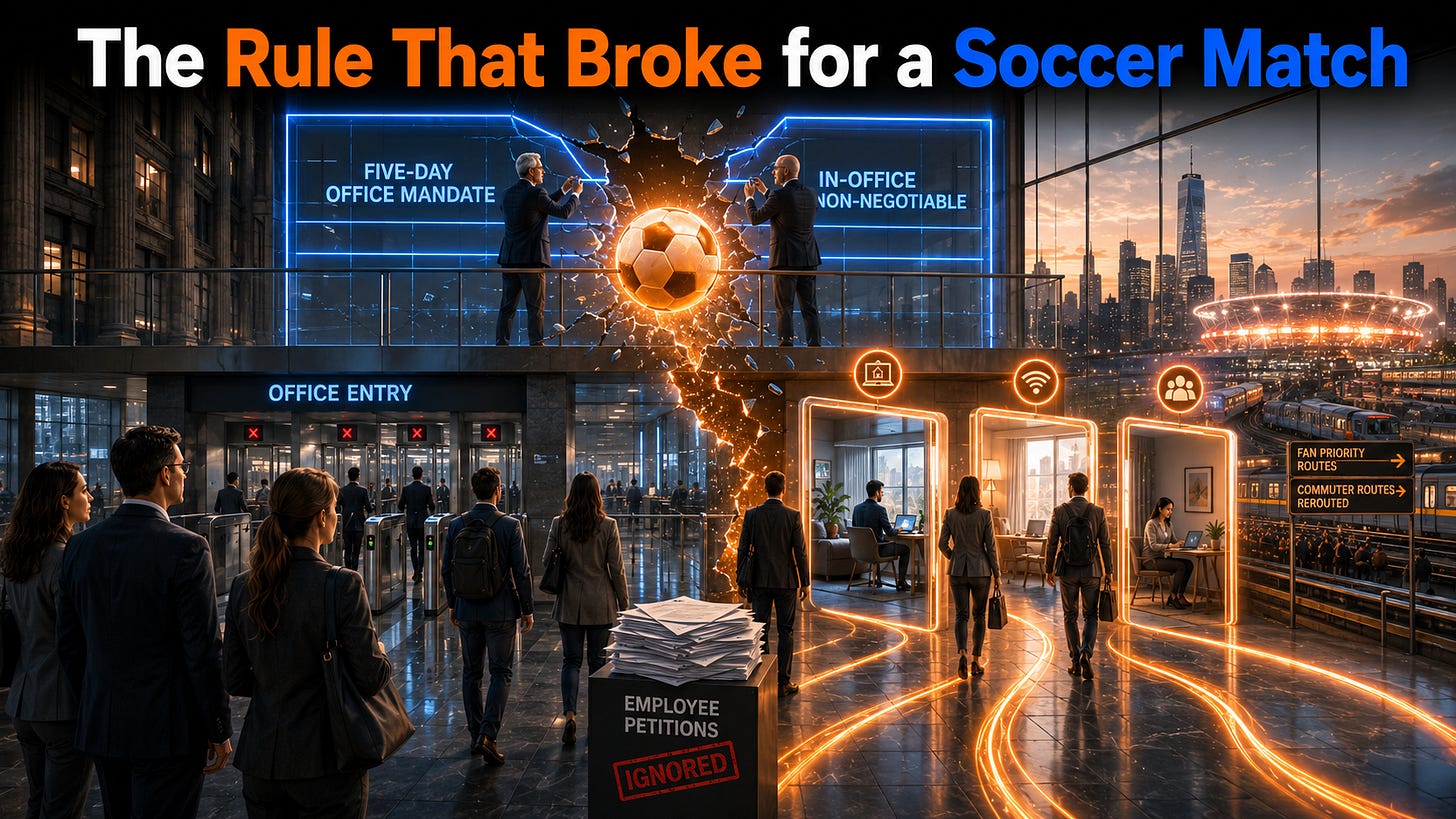
It wasn't a staff petition that got JPMorgan Chase CEO Jamie Dimon and Goldman Sachs CEO David Solomon to loosen their return-to-office grip. It was the World Cup. Internal memos seen by the Financial Times show JPMorgan Chase and Goldman Sachs are letting employees request remote work on 2026 World Cup match days. A soccer tournament, apparently, clears a bar a formal employee petition didn't.
Why it matters: Your return-to-office policy is only as credible as the first exception you make to it. Your workforce has already noticed which disruptions your leadership treats as real and which employee concerns it treats as noise.