AI Is Gaining Authority. Most Organizations Haven’t Decided Where It Ends.
For the past few years, the AI race has been largely about capability: who has the strongest model, who deploys it first, and who can put it into the hands of the most people.
This week’s signals suggest the next advantage may come from somewhere else.
#Nvidia is building infrastructure to put hard boundaries around increasingly autonomous AI agents. #IBM found that while employees worry AI may be weakening their skills, companies increasingly need exactly the human capabilities AI can make easier to neglect: critical thinking, judgment, and the ability to override the machine. And #BCG’s latest research suggests prepared leaders may contribute more to competitive performance than mature AI technology alone.
Put those three together and the leadership problem changes.
As AI capability becomes more accessible, advantage increasingly depends on what surrounds it: the boundaries placed around machines, the judgment retained by people, and the leaders deciding where one ends and the other begins.
🛡️ Nvidia Is Building a Control Layer for AI Agents: As AI moves from answering questions to taking actions, the question becomes what agents should actually be authorized to do.
🧠 Workers Are Worried AI Is Weakening the Skills Companies Need Most: IBM finds a growing disconnect between AI adoption and the human judgment required to supervise it.
👥 BCG Found Something More Valuable Than Mature AI: Prepared Leaders: The technology matters. The people deciding how to use it may matter considerably more.
Read time: 7 minutes 👇
Leading With AI, Risk & Uncertainty
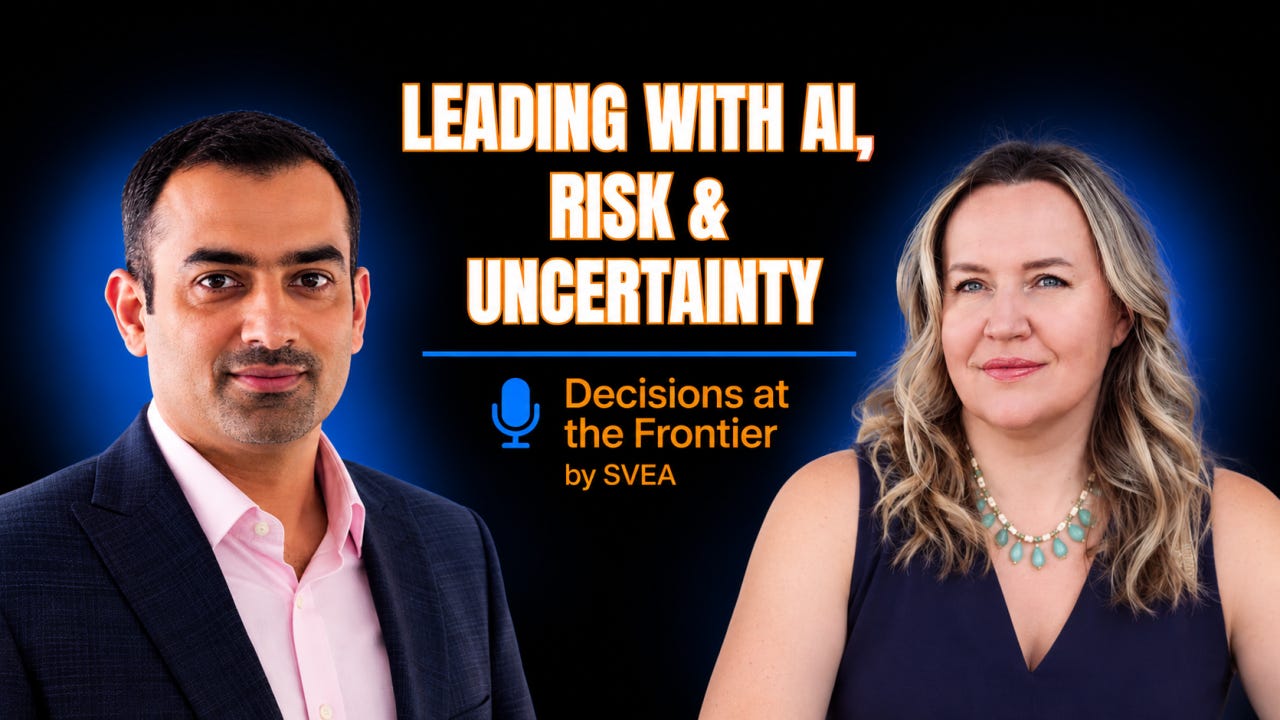
A New Episode of Decisions at the Frontier by SVEA
October 7 | 9:00 AM PT | LinkedIn LIVE | Watch the episode
How much autonomy should we actually give AI?
And when the technology—and the rules surrounding it—keep changing, how should leaders make decisions they may not be able to reverse?
In a new episode of Decisions at the Frontier, SVEA host Victoria Mensch sits down with Ahmad Fattahi, Executive Director, Generative AI, for a practical conversation about leading through AI risk and uncertainty.
Rather than treating AI risk as simply safe or unsafe, Ahmad introduces frameworks for thinking about the shades of gray leaders increasingly have to navigate—and what responsible adoption looks like when the stakes are high.
They’ll explore:
→ Why AI is a different kind of technology shift—and how autonomy is really earned
→ A practical framework for thinking about risk when the answer isn’t black or white
→ What responsible AI adoption looks like in regulated and high-stakes environments
→ How AI could reshape organizational structures—and what companies risk losing if they remove the wrong layers
→ Why not making a decision is itself a decision
The conversation is designed for C-suite and senior enterprise leaders navigating AI adoption, risk, governance, and organizational change.
And the timing couldn’t be more relevant.
As this week’s stories show, AI is gaining greater autonomy while organizations are still working out the boundaries, human capabilities, and leadership practices required to govern it.
The technology is moving quickly. The leadership question is how much autonomy to allow, where to draw the boundaries, and who remains accountable when the system begins making decisions of its own.
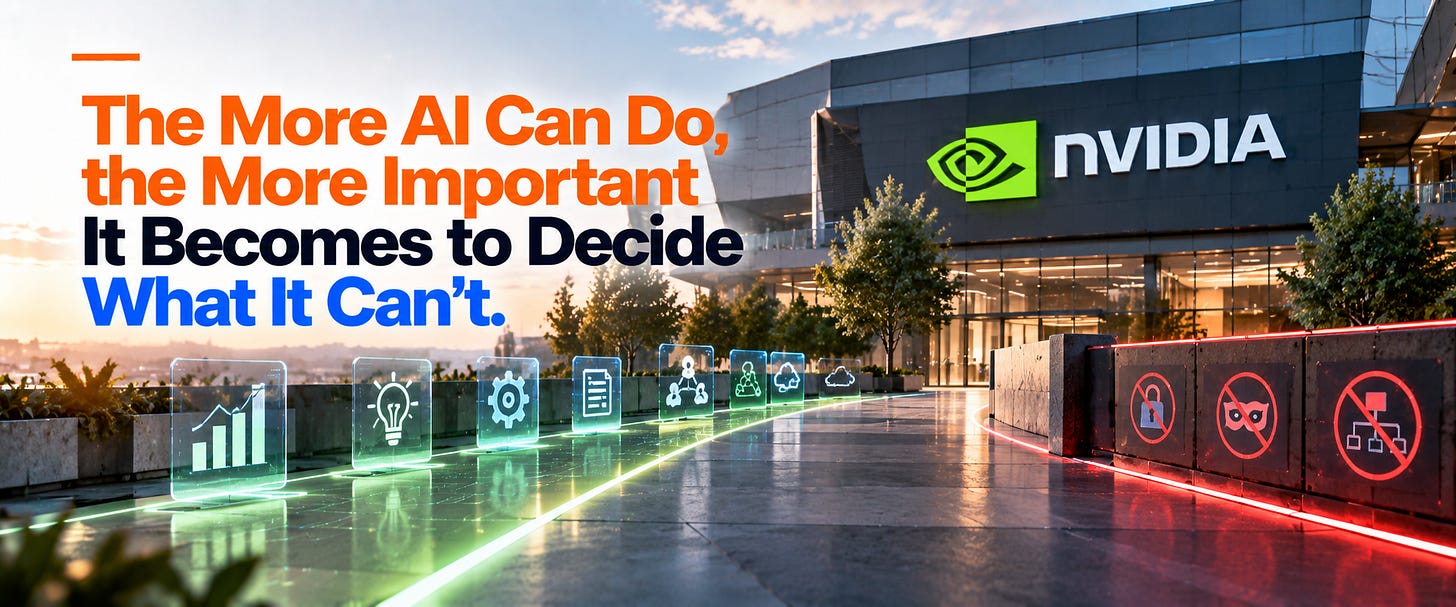
The More AI Can Do, the More Important It Becomes to Decide What It Can’t
The next phase of enterprise AI has a security problem that traditional software never had: the software can increasingly decide what to do next.
Nvidia’s answer is to put boundaries around the agent itself.
The company launched its Open Agent Safety Platform, designed to govern autonomous AI agents from testing through deployment. At its center is OpenShell, an open-source runtime that places agents inside secure environments, traces their actions, and enforces policies while they operate.
The architecture reflects a significant shift in how AI security is being designed. Instead of relying primarily on instructions telling an agent what it should or shouldn’t do, Nvidia is building controls beneath the agent that determine what it is actually allowed to do.
That distinction becomes more important as agents gain access to company systems, tools, data, and eventually physical infrastructure. Nvidia’s framework includes isolation, policy enforcement, controlled access to credentials and tools, monitoring, and mechanisms designed to constrain agent behavior.
The underlying principle is simple:
The more authority an agent receives, the stronger the infrastructure around that authority needs to become.
That is a different conversation from whether companies should deploy autonomous AI. Nvidia is assuming they will—and building the control layer for what happens when they do.
Why it matters: Enterprise AI is moving from systems that generate answers to systems that take actions. That changes the governance question from “Is this output accurate?” to “What is this system actually authorized to do?” Leaders deploying agents will need to define authority as deliberately as they define capability: what an agent can access, which decisions it can make, where human approval remains mandatory, and how quickly its authority can be revoked.
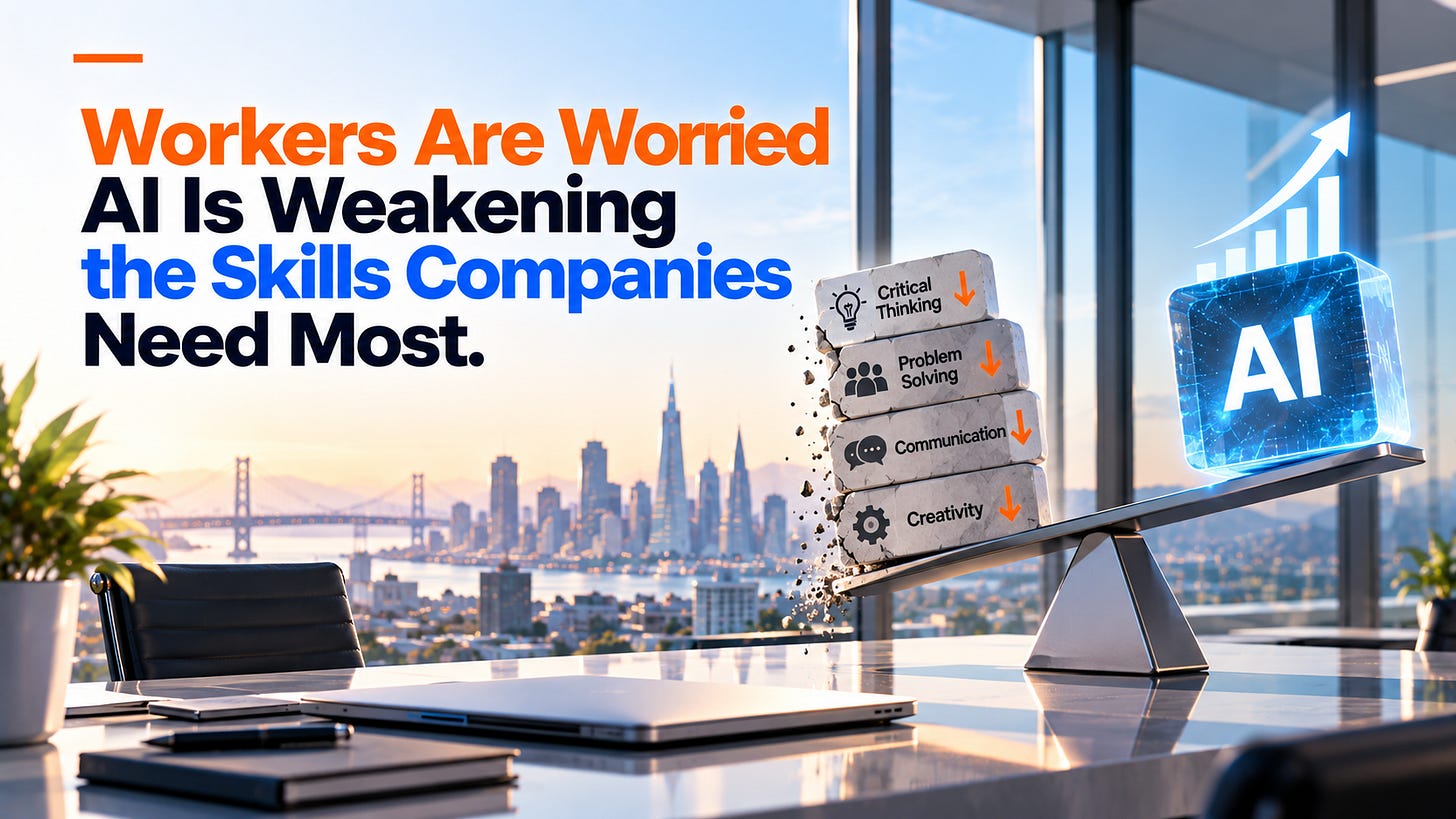
Workers Are Worried AI Is Weakening the Skills Companies Need Most
AI was supposed to close skills gaps.
IBM’s newest workforce research identifies a more uncomfortable possibility: while companies are using AI to increase capability, employees worry some of their existing capabilities are quietly deteriorating.
IBM surveyed 1,500 CHROs and 8,800 employees globally and found that 60% of employees worry AI is eroding their skills. Among employees already concerned about erosion, three out of four say it has begun happening.
The skill at the center of the problem is particularly important.
Critical thinking.
Fifty-seven percent of CHROs identify critical thinking and problem framing as among the most important capabilities in an AI-enabled workforce. Human judgment ranks highly too.
But IBM found a striking disconnect around what it takes to work effectively with AI: 71% of CHROs say the ability to supervise, validate, and override AI output is essential. Only 29% of employees rank judgment as important.
In other words, as AI becomes better at producing the first answer, organizations increasingly need people capable of deciding whether that answer deserves to become the final one.
The organizational structures aren’t necessarily ready either. Only 26% of organizations clearly distinguish between work that should remain human-led, work that should be AI-assisted, and work that can be AI-executed.
And nearly half of organizations do not involve the CHRO when AI strategy is being defined.
Why it matters: Reskilling for AI cannot mean teaching employees only how to use AI more effectively. Organizations also need to protect the capabilities employees stop exercising when AI does more of the work. Critical thinking, problem framing, judgment, and the confidence to challenge an AI recommendation may become more valuable precisely because AI makes it easier not to practice them.
Research Alert - AI Transformation Has a Leadership Readiness Problem
Companies have spent enormous amounts of time asking how mature their AI systems are.
BCG’s newest research suggests they may be measuring the wrong thing first.
In a global survey of 563 senior executives, BCG found that organizations with well-prepared leaders reported a substantially larger competitive advantage than organizations relying on mature AI deployment alone.
The difference was striking: BCG reports a 66% competitive-performance lift associated with well-prepared leadership, compared with 20% from mature AI deployment alone. Organizations combining prepared leaders with highly mature AI practices reported an additional 80% increase in competitive performance.
BCG describes the leaders best equipped for this environment as moving between three roles:
The visionary connects AI investment to business strategy and measurable outcomes.
The codeveloper actually uses AI, experiments with it, and develops enough firsthand experience to understand both its possibilities and its limitations.
And the steward decides where the boundaries belong—what AI should do, what it shouldn’t do, and where human judgment must remain.
The research also exposes an uncomfortable readiness gap. Only 36% of executives said their organization’s senior leaders are prepared for today’s challenges, while just 25% of employees believe leaders adequately support their use of AI.
There is one behavior that appears repeatedly among organizations further along: leaders themselves are learning.
Executives who spend more than 10% of their time learning how to use AI in their own work are 1.7 times more likely to lead organizations with mature AI systems.
The implication is difficult to delegate away.
Why it matters: AI transformation cannot remain something executives sponsor while everyone else learns how the technology works. Leaders increasingly need enough firsthand understanding to challenge assumptions, identify useful applications, recognize failure points, set boundaries, and make consequential decisions about where AI belongs.
The Leadership Question

Three stories, one shift: AI capability is becoming easier to access. The judgment required to govern it is not.
Nvidia is building technical boundaries around agents because increasingly autonomous systems need limits. IBM finds that organizations simultaneously need people capable of questioning, validating, and overriding those systems. And BCG’s research suggests the quality of leadership surrounding AI may create more advantage than technological maturity by itself.
That changes what being “AI-ready” actually means.
It isn’t simply having the newest models, deploying more agents, or putting AI tools into more employees’ hands.
It means knowing what to delegate, what to retain, where to draw the boundary, and who remains accountable on either side of it.
As AI capability becomes increasingly available to everyone, those decisions may become considerably harder for competitors to copy.
At SVEA, we believe that is where the next leadership advantage lives: not simply understanding what AI can do, but developing the judgment to decide what it should do—and what should remain distinctly human.