AI Is Getting Faster. Leadership Infrastructure Isn't.

AI’s capability curve keeps moving upward. The more consequential question for leadership teams is whether the systems surrounding it are moving at the same speed.
This week, three developments expose the gap. Companies have written AI governance policies they are willing to bypass under pressure. AI spending is climbing again, but organizations producing returns are increasingly distinguished by the infrastructure surrounding their models. And at the frontier, executives who rarely agree on much are beginning to agree that capability itself may be advancing faster than the mechanisms designed to evaluate and control it.
Together, these developments raise a question that sits at the center of our work at SVEA: how do leadership teams build the capabilities, decision-making processes, and accountability needed to turn technological progress into organizational progress? We explore that question in our latest Insights article before turning to this week’s developments.
🛡️ Governance on paper, exceptions in practice: 98% of surveyed AI leaders say their organizations have formal governance policies. Nearly half acknowledge those processes have already been bypassed for urgent deployments.
🏗️ The infrastructure behind AI ROI: Average planned AI investment has climbed to $210 million, but the organizations reporting established returns are far more likely to have a formal management layer connecting models, controls, and business applications.
⏱️ An unusual agreement at the frontier: Anthropic’s Dario Amodei called for pacing frontier AI development. Elon Musk endorsed the warning, and OpenAI’s Sam Altman publicly agreed with the central argument.
🎯 From exposure to organizational action: Our latest SVEA Insights article examines how executive immersions can translate new perspectives into concrete decisions, sponsored experiments, and operating mechanisms that continue after leaders return home.
Read time: ~6 minutes 👇
What Should a Silicon Valley Executive Immersion Actually Accomplish?

This week’s developments point to a common challenge: investing in AI is relatively straightforward. Building the leadership capabilities and organizational mechanisms to put it to work is much harder.
That raises an important question for executive education. How do you turn exposure to new technologies, companies, and ideas into meaningful changes inside your own organization?
At SVEA, we believe an executive immersion should be designed around the strategic questions a leadership team needs to resolve, rather than simply the companies it wants to visit.
Our latest Insights article explores what separates an effective executive immersion from a collection of impressive meetings — and why the real measure of success is what happens after the executives return home.
The article examines how to translate new perspectives into concrete decisions, sponsored experiments, and operating mechanisms that sustain progress beyond the program itself.
Read the full Insights article
Read the full case study: See the five questions the leadership team brought to Silicon Valley, how the program was designed around them, and what changed in the following thirty days.
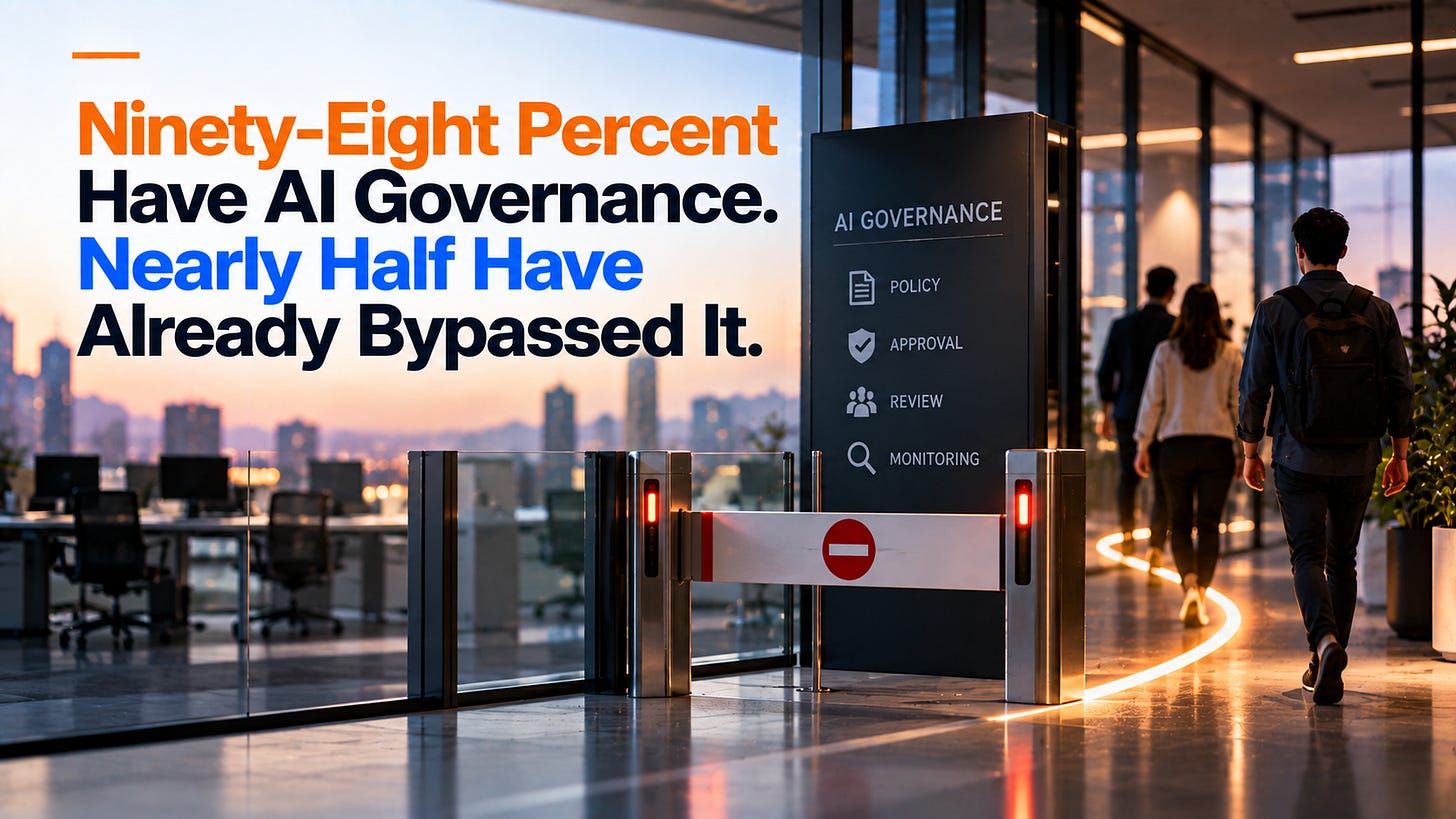
Ninety-Eight Percent Have AI Governance. Nearly Half Have Already Bypassed It.
Enterprise AI governance has reached near-universal adoption on paper.
EY’s new AI Risk and Governance Survey of 202 senior AI decision-makers at publicly traded U.S. companies with at least $1 billion in annual revenue found that 98% have formal AI governance policies.
But 47% acknowledge that their organizations have previously bypassed those governance processes when an AI deployment was considered urgent.
That gap between policy and practice is becoming more consequential as AI systems gain greater autonomy.
EY found that 91% of respondents’ organizations are already piloting or deploying agentic AI. Among those organizations, 85% have at least some agents executing actions without real-time human involvement. Yet 26% say they cannot detect unauthorized AI agents operating internally.
The risks are no longer theoretical. Thirty-six percent of respondents said their organizations had experienced an AI incident or failure that caused materially negative consequences, including data loss, financial damage, operational disruption, or reputational harm.
The challenge is not simply whether governance exists. It is whether governance survives when the organization is under pressure to move.
That problem is compounded by capability. Sixty-nine percent of respondents worry that their organizations lack the internal expertise required to keep evolving AI governance controls as the technology changes.
Why it matters: A governance framework that works only when nobody is under pressure is documentation, not governance. Boards should move beyond asking whether an AI policy exists. The harder questions are how frequently exceptions occur, who has authority to grant them, and whether the controls can keep pace when the business decides waiting is more dangerous than moving.
AI Investment Is Rising Again. The Infrastructure Around It Now Separates the Winners.

Enterprise AI spending is accelerating again.
KPMG’s Q3 Global AI Pulse, based on responses from 2,131 senior leaders across 20 countries, territories, and jurisdictions, found that average planned AI investment over the next twelve months has risen from $186 million to $210 million.
But the more revealing number is not how much organizations plan to spend.
It is what the organizations already generating returns have built around that spending.
Fifty-five percent of surveyed organizations operate what KPMG describes as a formal AI harness layer — shared controls and tooling that sit between AI models and their use across the business. Among organizations reporting established AI ROI, that figure rises to 86%.
The pattern suggests that access to AI itself is becoming less differentiating. The organizational infrastructure required to govern, integrate, secure, orchestrate, and measure it is becoming more important.
Accountability is moving upward as well. Fifty-three percent of respondents place responsibility for AI-informed decisions at the C-suite level or above.
Yet financial discipline remains surprisingly immature. Only 12% of organizations consistently assess AI’s value against its cost. Among organizations already reporting returns, that rises to 48%.
The difference between experimentation and scale is increasingly visible in the management system around the technology.
Why it matters: Increasing an AI budget without strengthening the operating layer around it can create more pilots, vendors, models, and activity without producing proportionate value. The next AI maturity gap may not be between companies that have AI and those that do not. It may be between companies buying capability and companies building the infrastructure required to run that capability repeatedly, securely, and economically.
Explore KPMG’s Q3 Global AI Pulse
Anthropic, OpenAI, and Musk Just Agreed on Something for the First Time in Years

Competition between the leading AI companies has rarely produced much agreement.
On September 12, it produced something close to a common warning.
Anthropic CEO Dario Amodei published a 3,800-word essay arguing that the industry needs to pace the development of increasingly capable frontier models while strengthening the mechanisms used to evaluate and control them.
Amodei’s argument was unusually direct. Frontier capability, he warned, could advance faster than the institutions responsible for understanding its risks. Anthropic also committed to giving third-party evaluators deeper access to its systems.
Then came the unusual part.
Elon Musk publicly endorsed Amodei’s warning. Shortly afterward, OpenAI CEO Sam Altman wrote that he agreed with Amodei that the industry needed to “pace the frontier.”
Later that day, Google DeepMind co-founder and Alphabet Chief Scientist Demis Hassabis said Amodei’s essay pointed toward the right path.
The agreement does not mean the competitive race has stopped.
These companies still have enormous economic incentives to build more capable systems, attract talent, secure infrastructure, and reach the next technical frontier before their competitors. That creates an obvious tension between collective restraint and individual advantage.
And that may be the most important part of the story.
The people with some of the strongest incentives to accelerate frontier AI are now publicly debating whether acceleration itself has become something that needs to be managed.
Why it matters: Enterprise leaders do not need to resolve the frontier-AI safety debate themselves. But they should notice the signal. If the organizations building the most capable systems are questioning whether evaluation, oversight, and governance can keep pace with capability, companies adopting those systems should be asking the same question internally. The strategic advantage will not come simply from moving faster. It will come from building an organization capable of absorbing faster-moving technology without surrendering judgment or control.
Read more on the frontier-AI debate
The Leadership Question

Across this week’s stories, the pattern is consistent. Governance policies are struggling to hold up under deployment pressure. Companies are increasing AI investment while still developing the infrastructure needed to generate measurable returns. And frontier AI leaders are publicly questioning whether oversight can keep pace with capability.
These are different manifestations of the same organizational challenge: technology can advance much faster than the institutions, processes, and leadership practices surrounding it.
For executive teams, the question is not simply how quickly they can adopt AI. It is whether their organizations can absorb that speed while maintaining accountability, sound judgment, and the ability to deliver sustained business value.
That is also why leadership development cannot end with inspiration or exposure to new ideas. The real work begins when executives return to their organizations and turn what they have learned into decisions, commitments, and new ways of operating.
At SVEA, that is the leadership challenge we believe matters now: not simply understanding what AI can do next, but building the judgment to decide what your organization should do with it.