AI Is Saving Time. What Are Companies Doing With It?
AI is helping employees complete tasks faster. But what happens to the time they save?
Does it shorten the customer’s wait? Create room to develop a new product? Help teams test an idea that previously required too much time or money? Or does it simply generate more work for the same approvals, handoffs, and reporting cycles?
This week’s research points to a growing leadership challenge: adopting AI and capturing its value are different tasks. The connection depends on decisions about customer outcomes, workflows, growth, and human contribution.
Those decisions are also at the center of our latest Decisions at the Frontier conversation.
Leading With AI, Risk & Uncertainty
Watch the Conversation | Decisions at the Frontier: Leading With AI, Risk & Uncertainty
Featuring Victoria Mensch and Ahmad Fattahi, Executive Director, Generative AI
A Silicon Valley Executive Academy conversation | October 7, 2026
Turning AI capability into business value requires decisions about autonomy, risk, accountability, and how work should change.
In our latest conversation, Victoria Mensch and Ahmad Fattahi explore:
How AI earns autonomy: Why greater capability does not automatically justify greater independence.
How leaders navigate uncertainty: Making decisions when risks are nuanced and the rules continue to evolve.
What organizational redesign puts at stake: Including what companies risk losing when they remove the wrong management layers.
The conversation brings a leadership perspective to this week’s research: as AI changes what people can do, executives must decide how their organizations should operate.
This Week’s Three Signals
The gap between saved time and financial returns: What McKinsey’s findings mean for measuring AI success.
Faster work, familiar structures: Why SAP’s research makes work redesign a leadership priority.
New tools, changing roles: What developer experiences suggest about expertise, accountability, and learning.
Read time: 5 minutes 👇
Individual Productivity Is Improving. Enterprise Returns Are Less Clear.
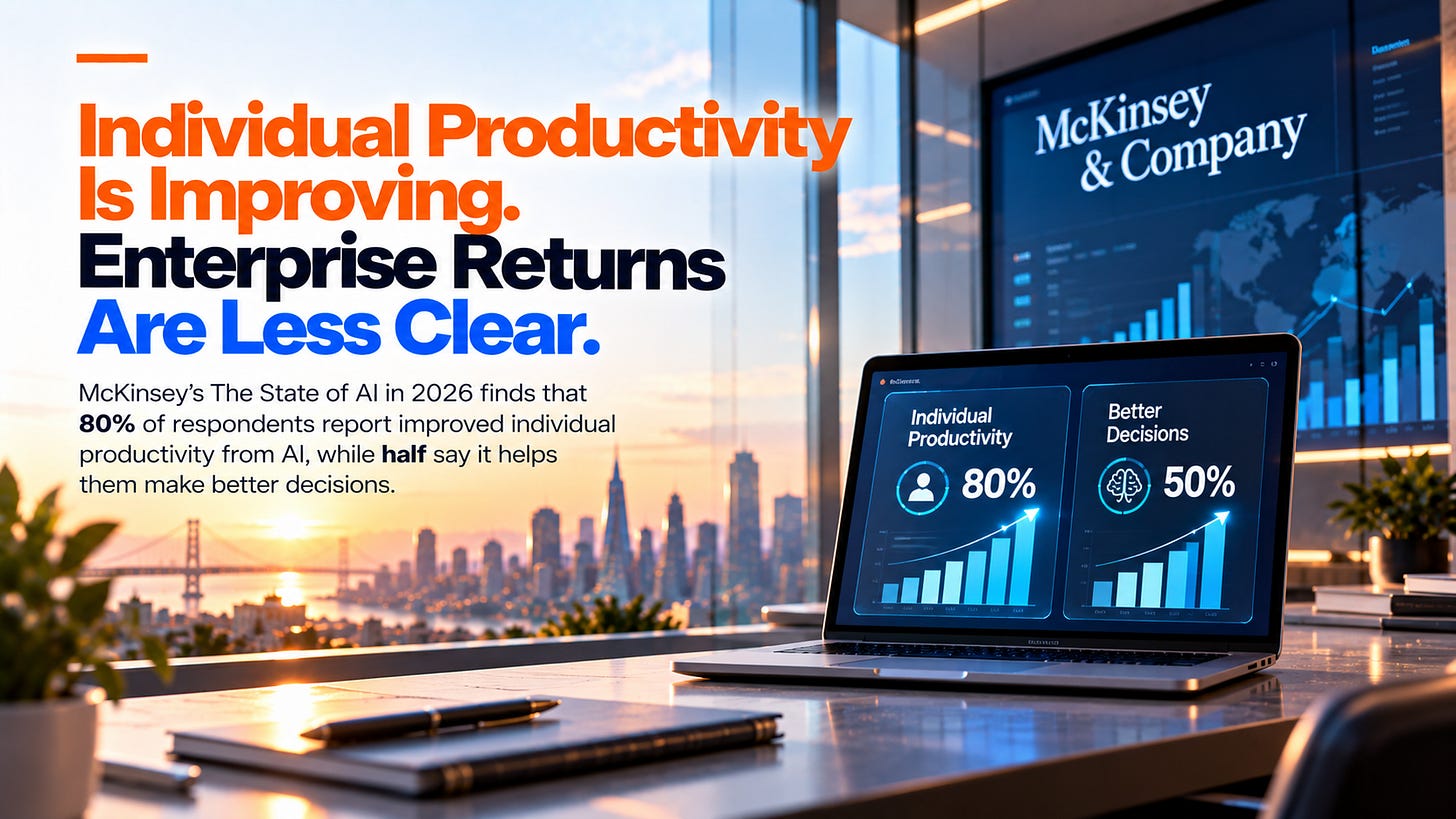
McKinsey’s The State of AI in 2026 finds that 80% of respondents report improved individual productivity from AI, while half say it helps them make better decisions.
Yet only 37% attribute a positive contribution to their organization’s earnings before interest and taxes to AI—essentially unchanged from the previous year. The share classified as AI high performers remains around 6%.
That gap deserves attention, but it needs careful interpretation. These are reported benefits and attributed financial effects. An absence of enterprise earnings impact does not mean an absence of value: respondents also report benefits within specific business functions and improvements in innovation, customer satisfaction, and competitive differentiation.
The leadership challenge is making those gains translate across the organization.
Saving time at one stage of a process may accomplish little if the next stage remains a bottleneck. Producing more proposals does not necessarily improve conversion. Generating more analysis does not necessarily improve decisions.
McKinsey’s high performers offer a useful direction. They pursue growth and innovation alongside efficiency, redesign workflows, and establish processes to measure impact. Nearly three-quarters report fundamentally redesigning workflows because of AI, compared with one-quarter of other respondents.
The leadership takeaway: Follow the saved time through to an outcome. What changed for the customer, the team, or the economics of the business? If the answer is unclear, the next investment may need to be in redesigning the process.
Source: McKinsey — The State of AI in 2026: On the Road to ROI
Faster Work Can Leave the Operating Model Intact
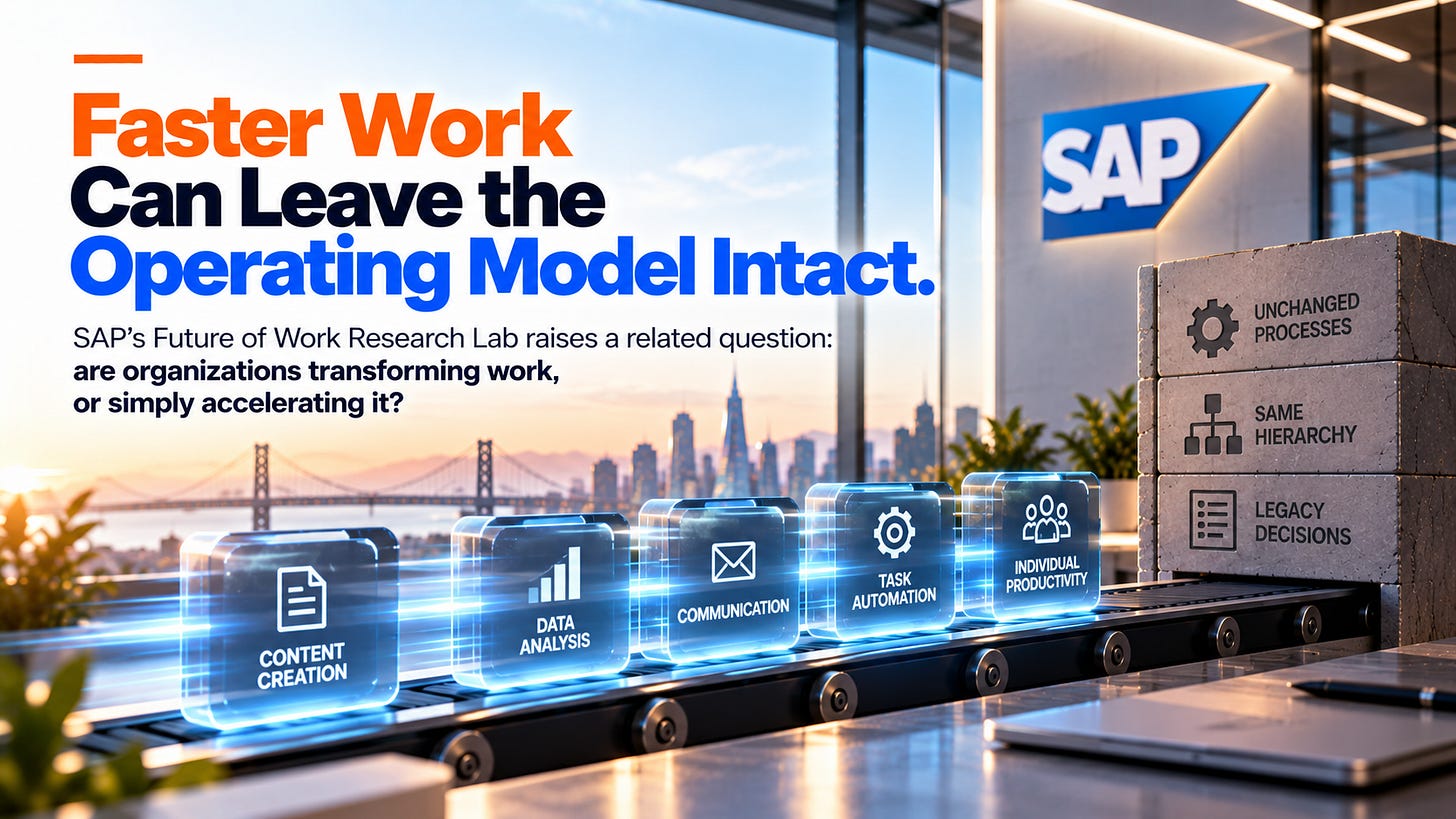
SAP’s Future of Work Research Lab raises a related question: are organizations transforming work, or simply accelerating it?
Its research combines more than 500 business, academic, government, and economic resources with original research involving employees, C-suite leaders, and HR executives.
Seventy-two percent of surveyed C-suite leaders say most organizations claiming to transform work with AI are actually automating existing jobs faster. That is an executive assessment, rather than a direct measurement of every organization’s practices, but it points to a recognizable problem.
An employee can prepare a report in minutes while the organization still requires the same reporting frequency, review meetings, and approval chain. AI changes the task; the surrounding structure stays intact.
SAP also finds that, depending on the work shift examined, 55% to 70% of employees report receiving no clear organizational guidance about the changes they are expected to navigate.
Without a shared direction, local experimentation can produce useful improvements that never add up to a stronger operating model.
This is where the Silicon Valley innovation playbook becomes relevant: question the problem before optimizing the solution, test assumptions through small experiments, and evaluate what changes for the customer.
Applied to AI, that means asking whether a task should be accelerated, simplified, combined with another task, or eliminated.
The leadership takeaway: Select one workflow with a clear business outcome. Bring together the people responsible for its different stages, identify the main constraint, and test a redesigned approach. Measure the result across the workflow—not just the time saved by one employee.
For Talent & Learning leaders, this creates a concrete development priority: helping managers lead experiments, work across functions, and redefine responsibilities as human and AI contributions change.
Source: SAP — Spoiler Alert: The Future of Work Is Already Here
AI Adoption Changes the Work. Leadership Must Address the Role.
Stack Overflow’s 2026 Developer Survey offers a useful view of a profession already working extensively with AI.
Around 62% of respondents to its AI sentiment question express favorable attitudes toward the tools. Yet among those answering the job-satisfaction question, only 22% are classified as happy at work, approximately 33% as unhappy, and 45% as complacent.
These figures do not show that AI causes dissatisfaction. They show that enthusiasm for a tool and satisfaction with a job are different measures.
The leadership question is what happens when the work changes.
As developers use AI to generate code, their contribution can shift toward framing problems, reviewing outputs, testing reliability, and making judgments about what should reach production. Those responsibilities require expertise, even when less code is written manually.
Organizations need to make that contribution visible. Who owns the outcome? What must be verified? How will less experienced employees develop judgment if AI performs tasks through which they previously learned?
The survey’s trust findings reinforce this point: the largest group trusts AI when its outputs can be easily verified.
The leadership takeaway: Review role expectations alongside AI adoption. Measure quality, learning, and accountability as well as output. More generated work has limited value if teams lack the expertise or capacity to evaluate it.
Source: Stack Overflow — 2026 Developer Survey
From Saved Time to New Value
The opportunity extends beyond completing today’s work faster. AI can lower the cost of experimentation, make new services possible, and give teams capacity to address problems they previously could not.
Realizing that opportunity requires leaders to decide where the released capacity should go.
Three questions can help start the discussion:
1. What outcome are we trying to improve? Define the customer or business result before selecting the AI application.
2. What must change around the technology? Examine handoffs, approvals, incentives, and ownership.
3. What will people do with the capacity created? Make room for experimentation, customer insight, better decisions, or new offerings—and measure whether that happens.
At Silicon Valley Executive Academy, we help organizations, teams, and executives tap into the Silicon Valley innovation playbook through executive immersion programs and leadership development. That includes examining how practitioners frame problems, test emerging technologies, and organize teams to turn ideas into business outcomes.
If your leadership team is navigating this transition, reply with the workflow or business challenge you are working on. We can explore how a tailored SVEA program could support it.