🚀 How AI Leaders Redesign Organizations for Growth
The most successful leaders aren't just adapting to AI—they're completely reimagining how organizations operate, grow talent, and compete in markets that didn't exist five years ago. But there's a catch: the strategies that got companies here won't get them there:
- 🎯 The Leadership Shift: Why traditional management approaches are failing in AI-driven environments
- 🏗️ Organizational Redesign: How tech giants are restructuring to accelerate talent development at unprecedented speed
- ⚡ The Three-Pillar Framework: The digital strategy blueprint that's separating market leaders from everyone else
Read time: less than 5 minutes 👇
Transform NOW: Leadership in an AI-Driven World
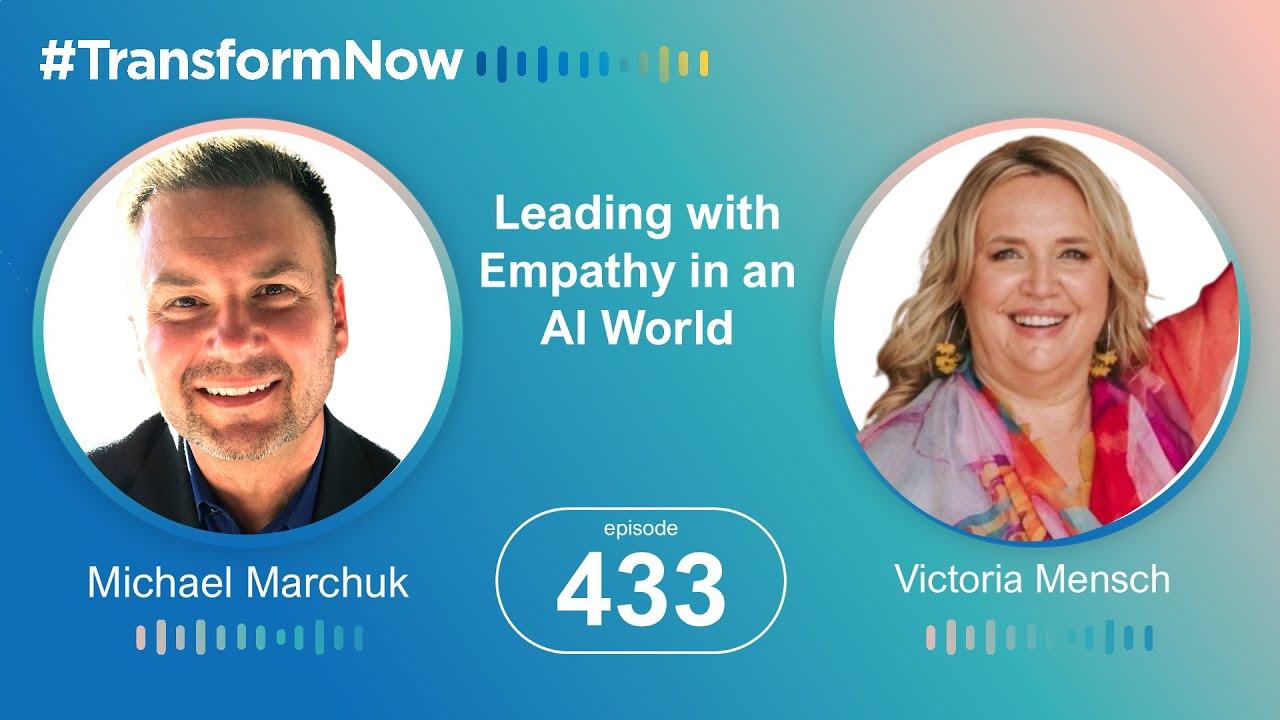
Leadership is undergoing a fundamental shift as artificial intelligence reshapes how we work and lead teams. Dr. Victoria Mensch breaks down why traditional command-and-control approaches are failing and what leaders need to do instead.
Key Points:
- Legacy mindsets focused on control and authority are becoming obsolete in the AI era
- Disruption readiness requires adapting leadership style for constant change instead of fighting it
- Burnout prevention depends on sustainable work practices and consistent self-care for executives
- Empathy and delegation become more valuable as AI takes over routine tasks
- Strategic AI adoption means using technology as a leadership multiplier rather than viewing it as a threat
Why It Matters: Leaders who adapt these human-centered skills now will stay relevant while others get left behind by technological change.
Source: SVEA Transform NOW Podcast
Three Pillars Transform Digital Strategy Into Competitive Advantage

The era of gradual digital change is over. Companies now face a complete strategic reset where AI-native systems, quantum-ready infrastructure, and ecosystem orchestration separate industry leaders from those left behind.
Key Points:
- Legacy system modernization through automated migration prevents costly disruptions while addressing skill gaps
- Integrated cybersecurity must become a business enabler rather than an innovation roadblock
- Strategic planning requires 3-4 measurable KPIs that align technology initiatives with clear business outcomes
- Cultural transformation determines whether digital tools create lasting organizational value
Why It Matters: Organizations that delay comprehensive digital transformation risk obsolescence in a $1.86 trillion market where incremental innovation has become a competitive liability.
Source: Appinventiv
Tech Companies Redesign Organizations to Accelerate Talent Growth

Technology companies are redefining talent development by moving beyond traditional HR practices to create organizational structures that accelerate career growth. Companies like Spotify, Stripe, and Rokt demonstrate how intentional design, flat hierarchies, and rapid feedback systems can compress decades of career advancement into years.
Key Points:
- Spotify pioneered autonomous squad models with 6-12 person cross-functional teams, though scaling revealed coordination challenges that other companies now address proactively
- Stripe builds craft-first culture through operating principles, dual career tracks for engineers and managers, and documentation systems that enable internal mobility and knowledge sharing
- Rokt engineers flat hierarchies with "Builder DNA" characteristics, maintains maximum two layers between contributors and executives, and replaces six-month reviews with six-week coaching cycles
Why It Matters: These organizational experiments prove that company architecture determines how fast ambitious professionals can advance, making structure as important as talent in competitive markets.
Source: USA Inquirer
CEOs Build Momentum Through AI and Talent Investment

CEOs are stepping into 2026 with mixed feelings—confident in their companies but worried about the global economy. While 90% expect their own businesses to grow, rising costs and economic uncertainty are forcing leaders to make tougher choices about where to invest their money.
Key Points:
- CEO confidence dropped from 83.0 to 78.5 as leaders worry about slower global growth and geopolitical tensions
- 61% of CEOs expect higher business costs in 2026, with only 16% anticipating cost reductions
- Leaders remain optimistic about talent retention and AI technology as competitive advantages
- Companies are shifting from broad AI experimentation to targeted scaling in specific business units
Why It Matters: Organizations that combine sharp cost discipline with strategic AI investments and talent development will create their own momentum despite economic headwinds.
Source: EY CEO Outlook Global Report
Book Your 30-Minute Leadership Strategy Session
Meet one-on-one with a Silicon Valley Executive Academy advisor to explore how our programs can help you: • Strengthen your leadership skills and executive presence • Promote innovation and team productivity inside your organization • Build sustainable work–life harmony while driving growth This no-obligation call is your first step toward stronger teams, smarter strategy, and a life that truly works.