AI speeds up business, but leadership development stays slow
Freshworks cut 11% of its workforce this year and posted its first profitable quarter within two fiscal quarters of the decision. That’s the new baseline for how fast an AI-linked restructuring now has to prove itself.
Building a pipeline of leaders who can run that faster-moving business is a much slower project, and this week’s data suggests most companies haven’t started building it in earnest. Ninety-three percent of Gen Z interns already expect to reach the C-suite, but internal mobility research shows employees rarely turn skill-building into an actual next role without direct manager involvement.
How fast a business can restructure and how slowly it develops the people meant to run the restructured version of it are moving at two different speeds — and that mismatch is where the real risk sits.
🏗️ Freshworks cut 11% of its workforce. It just posted its first profit.: A tight, provable line from AI restructuring to the P&L — most companies can’t match it.
🧠 Employees are staying put and still not getting promoted: Job hugging is up. Advancement isn’t following it.
🤖 93% of Gen Z interns want the top job, but they don’t want the hours.: Career ambition is high; tolerance for shortcuts to get there isn’t.
Read time: 6 minutes 👇
Culture Before Crisis — A Conversation with Maxim Williams, Vice President of Global Culture & Belonging at Autodesk
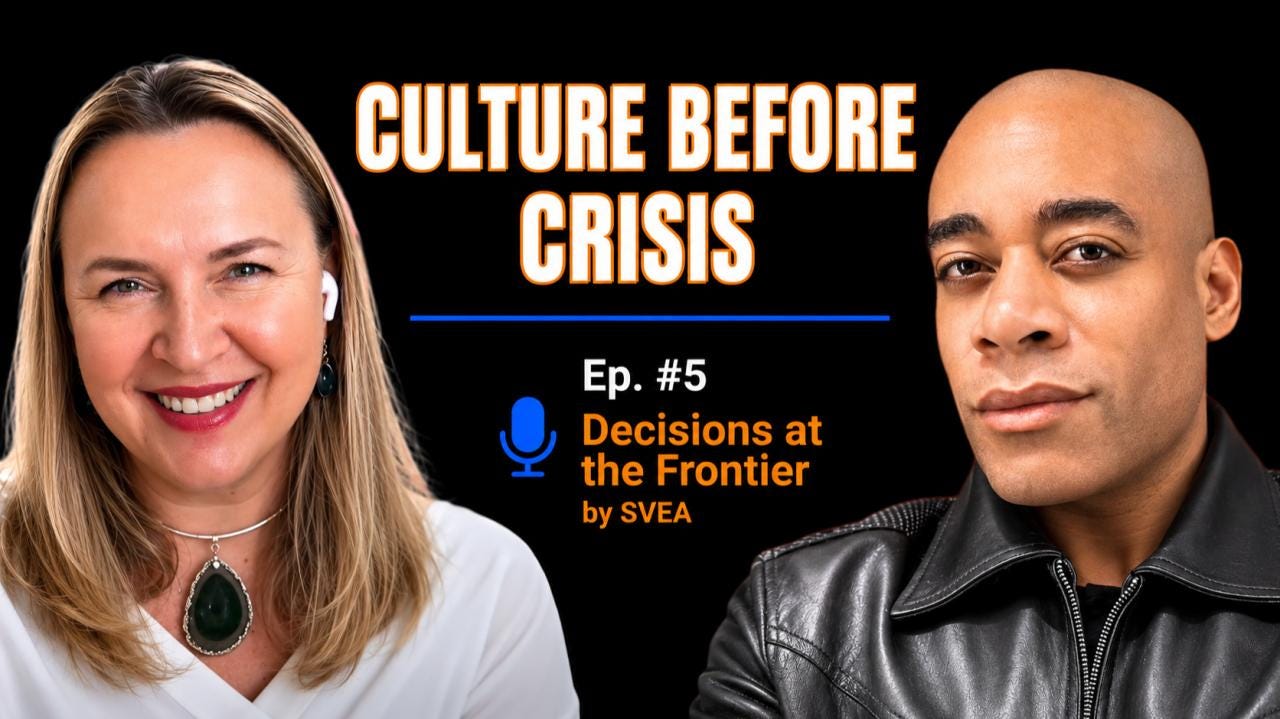
As AI reshapes decision-making and job design across the enterprise, culture stops being a soft metric and starts being the thing that determines whether any of it actually sticks.
In Episode 5 of Decisions at the Frontier, our host Victoria Mensch sat down with Maxim Williams, Vice President of Global Culture & Belonging at Autodesk, for a conversation on why culture is one of the most important strategic assets an organization can build, drawing on his leadership experience across Apple, Gap, Roku, and Autodesk.
In this episode, Victoria and Maxim explored:
Building learning systems that outlast a single leader’s tenure
Treating culture as a strategic asset rather than an HR line item
How AI is already reshaping day-to-day decision-making inside Autodesk
Freshworks cut 11% of its workforce. It just posted its first profit.
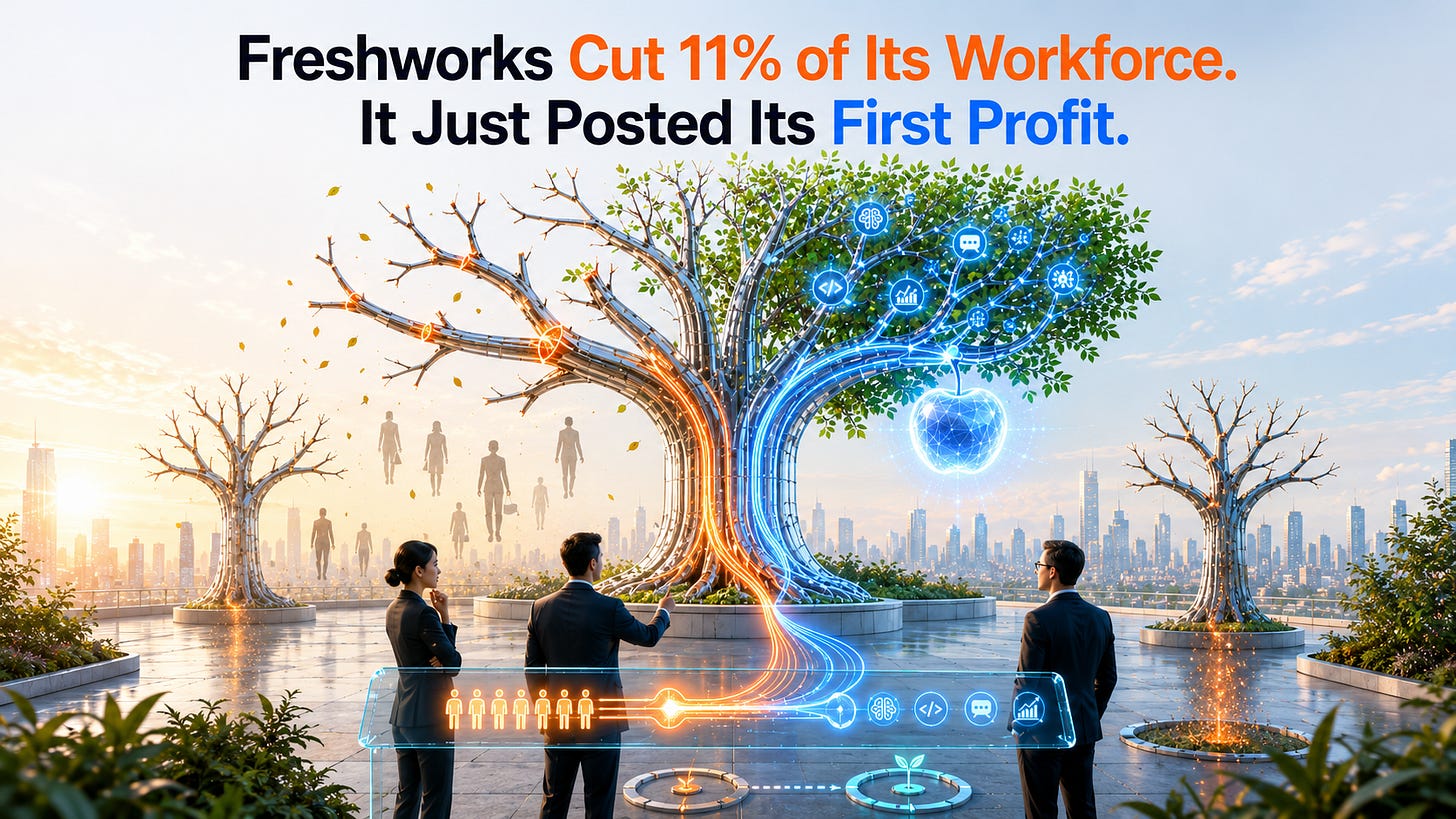
Freshworks laid off roughly 500 people, about 11% of its workforce, as part of an AI-led reorganization earlier this year. This week it posted its first GAAP-profitable quarter in company history.
Revenue rose 16% year over year to $237.4 million, swinging from a $1.7 million net loss a year earlier to a $3.2 million profit, months ahead of the company’s own timeline. Freshworks raised full-year guidance to as much as $966.5 million and reported that its Freddy AI Copilot is now attached to more than 71% of new enterprise deals. CEO Dennis Woodside framed the quarter as a “pattern of execution,” pointing to seven straight quarters of beating revenue estimates.
The sequencing is worth studying. Freshworks didn’t cut headcount and hope AI eventually justified the decision after the fact. The reorganization was explicitly framed around simplifying operations, reducing management layers, and reallocating investment toward AI products, and the profitability followed within two quarters, not two years.
Why it matters: The test for any AI-linked restructuring isn’t whether headcount went down, it’s whether the freed-up capital visibly funded something that moved the P&L within a couple of quarters. If a company’s own AI reorganization can’t point to a comparably short, comparably specific line from cuts to results, it has absorbed the pain without collecting the proof.
Employees are staying put and still not getting promoted
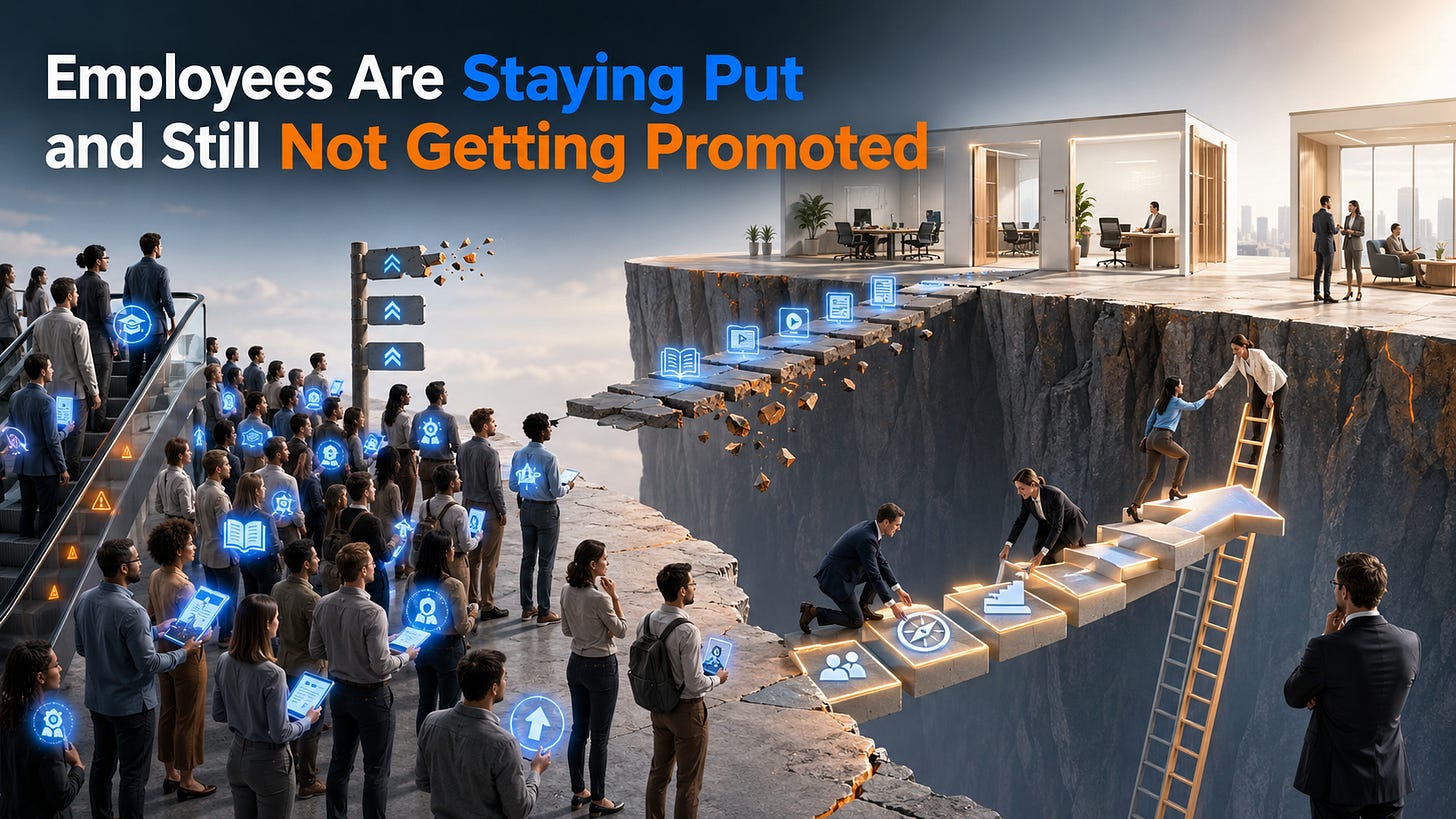
Employees are staying. They’re just not moving up while they stay, and that disconnect has a name now: the “mobility cliff.”
A new Harris Poll study commissioned by EdAssist by Bright Horizons finds 77% of employed workers would prefer to remain with their current employer if clear internal advancement paths existed. The instinct to stay, sometimes called “job hugging,” is already widespread. What’s missing is the second half of the equation: 83% of employees say they’re motivated to build new skills for career advancement, but 47% don’t know where to start.
The data points to a specific mechanism, not a vague culture problem. Employees with managers actively involved in their development are 43% more likely to advance after completing training, compared with 28% for those without that involvement. Yet despite 64% of employees saying their manager is at least somewhat involved in guiding their skill development, only a third report having actually had a conversation about building relevant skills in the past year, up from 28% in 2024 but still a minority.
Companies like CVS Health and Synchrony are responding by building explicit, named pathways connecting specific training programs to specific next roles, rather than treating upskilling and promotion as separate initiatives.
Why it matters: An employee who stays but doesn’t advance isn’t a retention win, they’re a slower-motion flight risk. If an organization can’t point to a documented link between a specific training investment and a specific next role, it’s funding education without funding the mobility it’s supposed to produce.
93% of Gen Z interns want the top job, but they don’t want the hours.
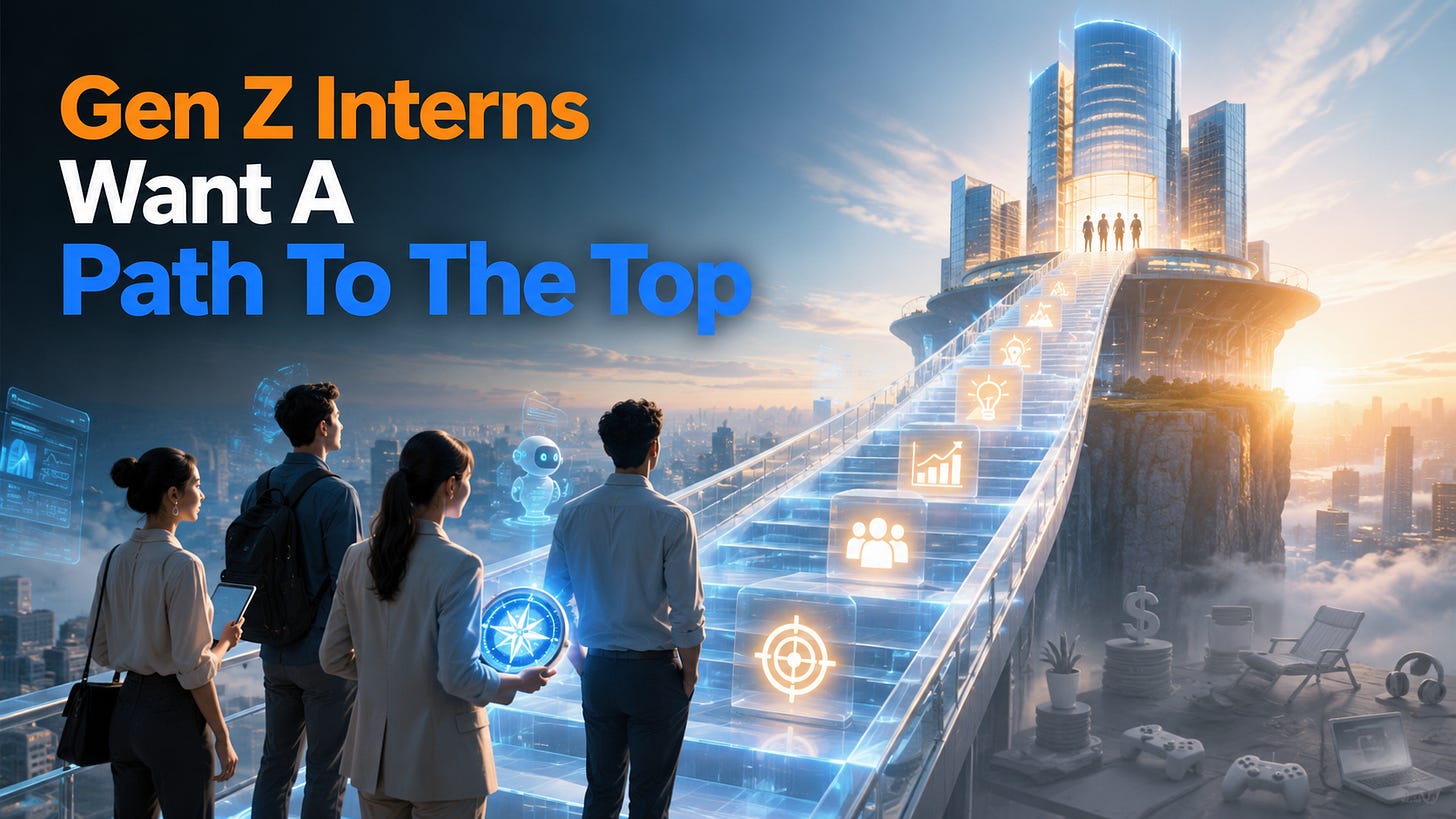
Ask Gen Z interns what they want most from a full-time employer, and the answer isn’t flexibility or salary. It’s a credible path to the top.
KPMG’s Summer Intern Pulse Survey, fielded in July among more than 900 interns, found career growth ranked as the single most important factor in choosing a full-time employer, ahead of work-life balance, salary, workplace culture, and access to new technology. The ambition attached to that priority is specific: 93% expressed at least some interest in eventually reaching the C-suite or a senior executive role.
What’s notable is how this generation frames AI’s role in getting there. Ninety-four percent expect AI to automate or meaningfully enhance more than a fifth of their future job. Rather than treating that as a threat, most see it as table stakes: they rank critical thinking, not AI fluency itself, as the skill most likely to separate entry-level employees over the next five years. KPMG’s Derek Thomas put the risk plainly: lean on AI for all the early thinking, and the instincts that make a strong employee never get built.
Why it matters: Entry-level programs optimized around AI-tool proficiency rather than judgment-building assignments may be training for the wrong differentiator. The interns most likely to become the next generation of leaders are already signaling that they want to be stretched, not just equipped.
Every organization now has the tools to move fast. Far fewer have seriously worked out who’s supposed to be ready when the faster version of the business needs a new person running it. That imbalance won’t correct itself, and it won’t appear on this quarter’s dashboard. The leaders worth watching over the next few years won’t be the ones who executed the sharpest restructuring. They’ll be the ones who can already name, without hesitation, who takes over next.