How a 75,000-letter resignation got a CEO removed.
AI’s price tag was supposed to show up as a line item on the token bill. This week it showed up everywhere else: in a 75,000-character resignation letter that cost a CEO his job, in a compensation conversation quietly adding a line nobody negotiated for before, and in a bond market re-underwriting itself around a single technology theme. AI didn’t rewrite any of these relationships. It just forced them to read the fine print.
🧠 A 75,000-Character Resignation Letter Just Cost A Chinese Tech CEO His Job: One employee’s burnout confession went viral — and toppled the executive who caused it.
🤖 Nvidia To Pay Employees In AI Tokens?: Compensation packages are quietly adding a line item nobody negotiated for yet.
⚡ Wall Street’s New Asset Allocation Rule Isn’t Stocks vs. Bonds. It’s AI vs. Everything Else.
Read time: 5 minutes 👇
Culture Before Crisis — A Conversation with Maxim Williams, Vice President of Global Culture & Belonging at Autodesk
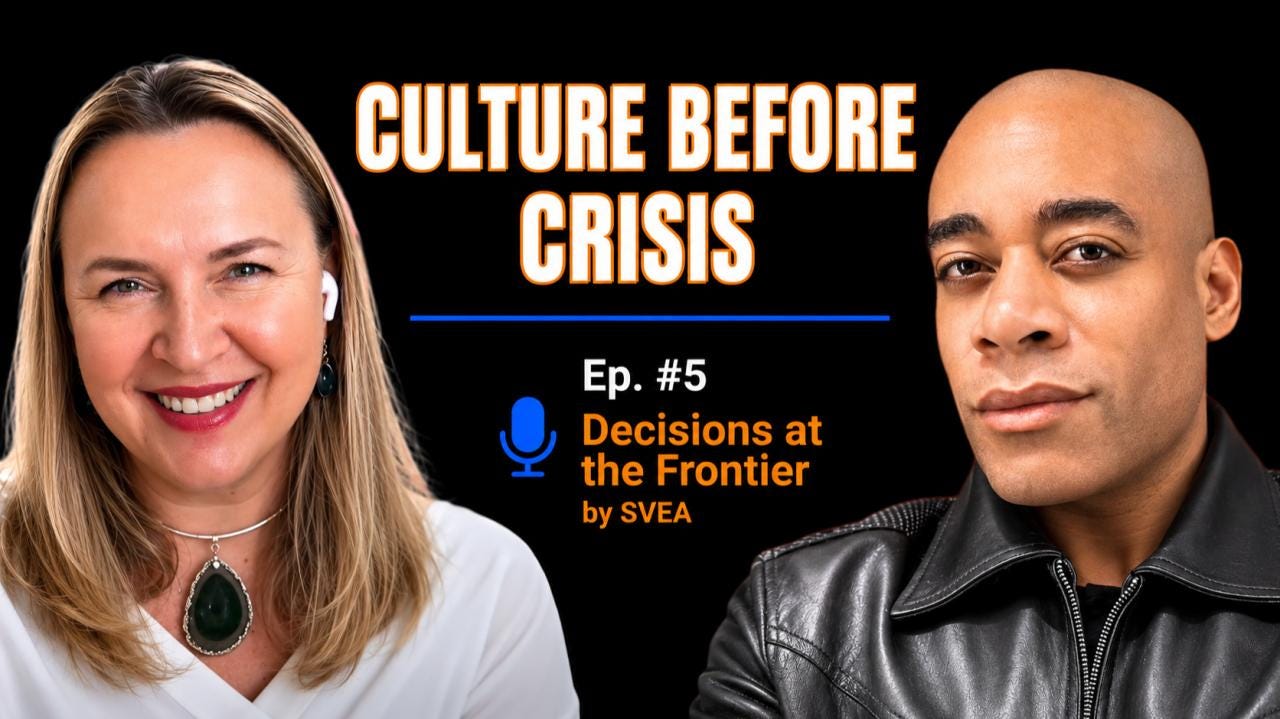
As AI reshapes decision-making and job design across the enterprise, culture stops being a soft metric and starts being the thing that determines whether any of it actually sticks.
In Episode 5 of Decisions at the Frontier, our host Victoria Mensch sat down with Maxim Williams, Vice President of Global Culture & Belonging at Autodesk, for a conversation on why culture is one of the most important strategic assets an organization can build, drawing on his leadership experience across Apple, Gap, Roku, and Autodesk.
In this episode, Victoria and Maxim explored:
Building learning systems that outlast a single leader’s tenure
Treating culture as a strategic asset rather than an HR line item
How AI is already reshaping day-to-day decision-making inside Autodesk
Watch the full replay on LinkedIn — YouTube upload coming soon.
A 75,000-Character Resignation Letter Just Cost A Chinese Tech CEO His Job
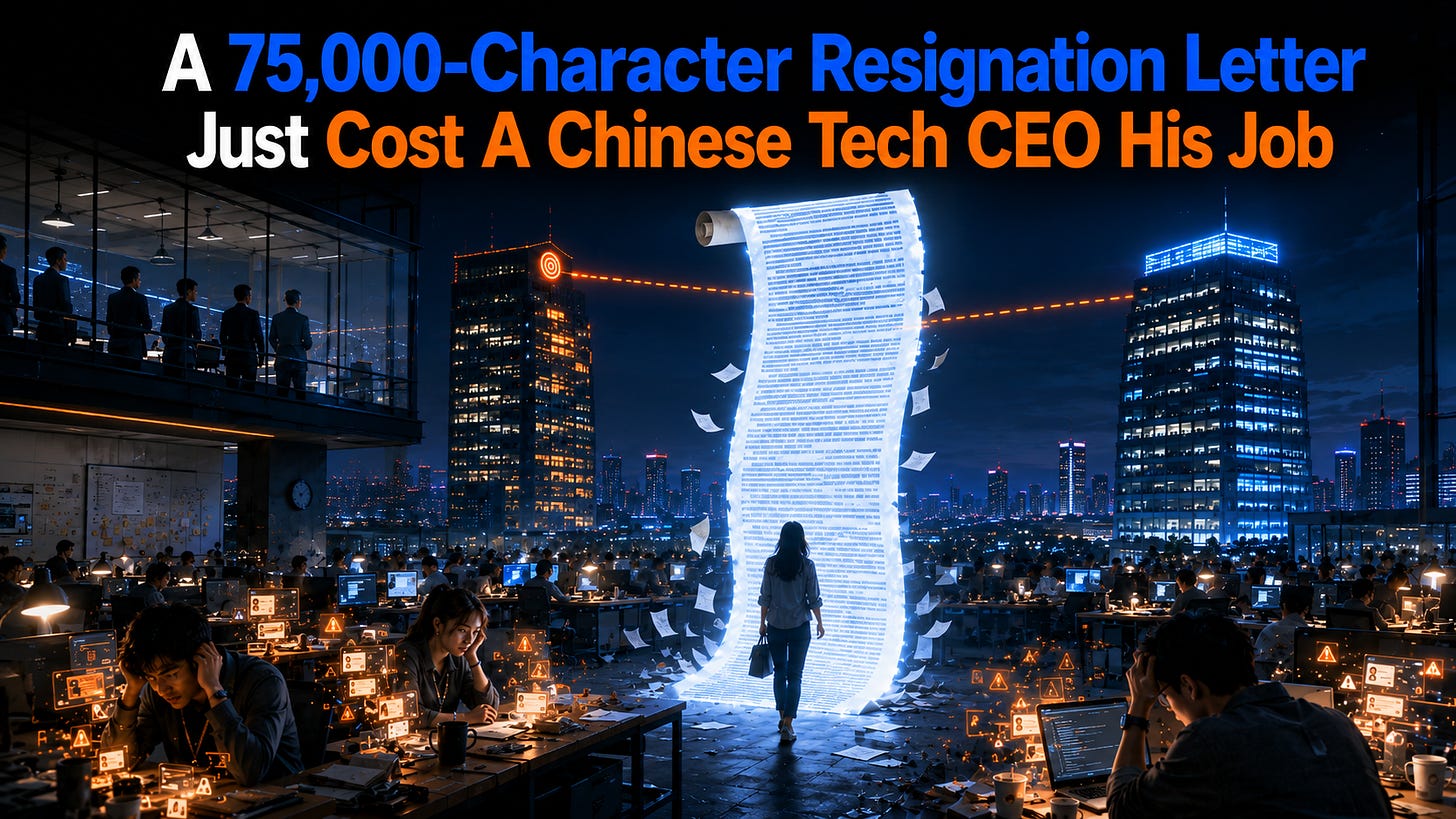
A product manager at Alibaba’s DingTalk, Teng Yaxin, posted a resignation letter roughly the length of a book on the company’s internal forum in June. It took readers hours to get through. The message underneath was simple: the team behind an app used by hundreds of millions of Chinese office workers to manage their own jobs had a toxic workplace itself, and she was one of its casualties.
Teng, whose account was later reported by The Paper, described her team being ordered to stay in the office until midnight, specifically to watch whether the lights at rival ByteDance’s Feishu office turned off first — a ritual meant to signal that “our own lights don’t go out.” The AI tool the pressure was meant to produce lost users and was eventually scaled back anyway. The letter’s virality was fierce enough that Alibaba’s senior leadership publicly criticized the team’s management style, and CEO Chen Hang was removed, a move Chinese outlet Late Post called rare even by Alibaba’s standards.
The pattern underneath is one every competitive workplace will recognize: decisions driven not by strategy but by fear of what a rival might be doing, producing effort with no clear destination. Teams in that state don’t burn out because the work is hard. They burn out because no one can explain what the work is for. A former DingTalk vice president, Ma Ruila, called the letter proof that “a young product manager full of ideas had to write more than 70,000 characters to keep herself from drowning in a system.”
Why it matters: When your team can’t articulate why a project matters beyond “the competitor is still working,” you’ve swapped strategy for fear-mimicry, and fear-driven effort burns out your best people faster than it beats your rivals. If your own AI initiative is justified mainly by what a competitor might be doing rather than a clear outcome, that’s the sign to investigate before someone writes the letter.
Nvidia To Pay Employees In AI Tokens?
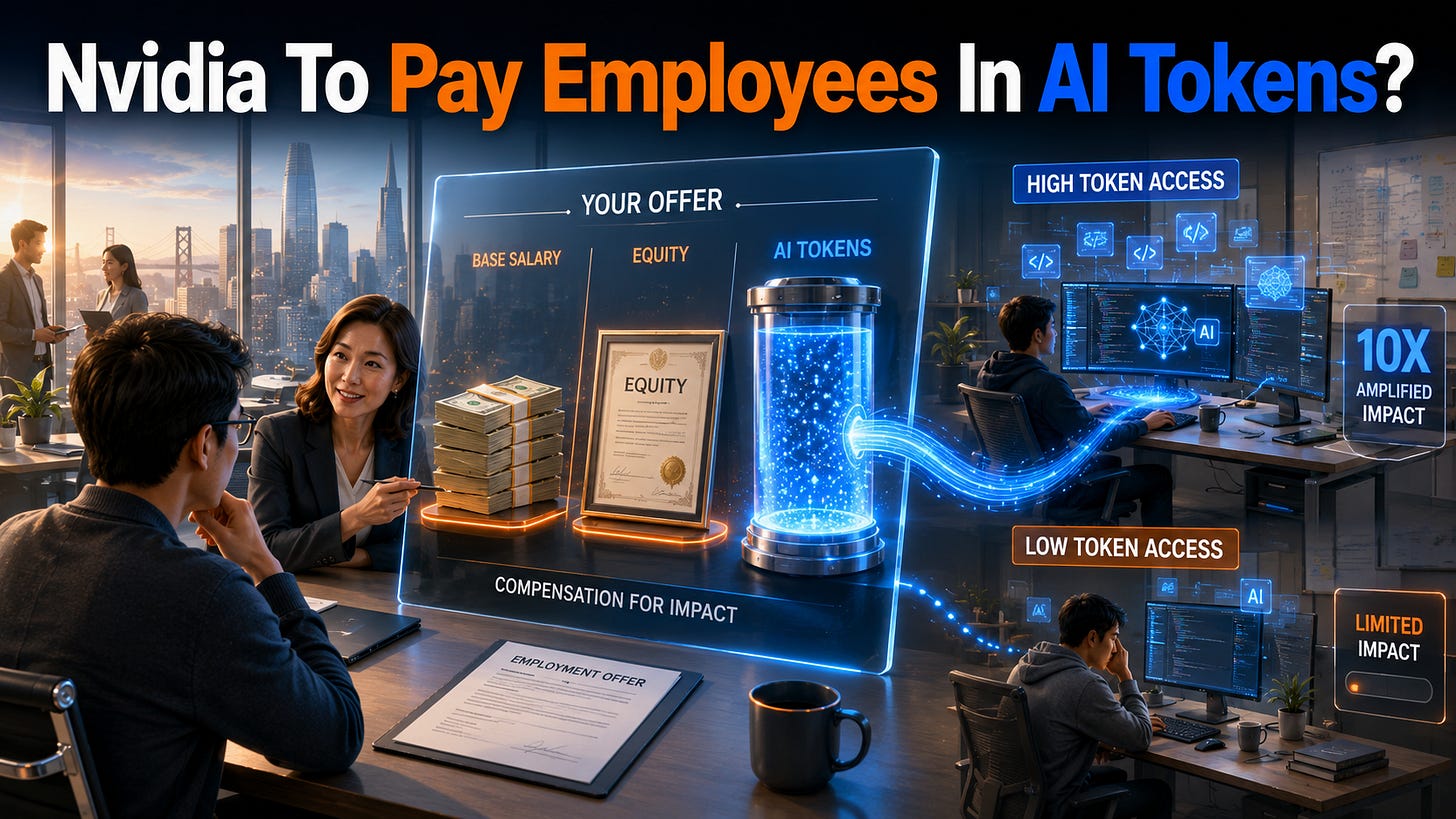
“It is now one of the recruiting tools in Silicon Valley: how many tokens come along with my job?” That’s how Nvidia CEO Jensen Huang described a shift happening in tech hiring, speaking at Nvidia’s GPU Technology Conference. AI token budgets, the amount of AI compute an engineer gets to do their job, are becoming a standard line in offer letters alongside salary and equity, not a replacement for either.
Tokens are the units AI models consume to read a prompt and generate a response, and they aren’t infinite. They cost real money to create and use, which makes a company’s willingness to hand engineers a generous allotment a meaningful signal about how much they can actually build with the tools they’ve been given. Thibault Sottiaux, engineering lead at OpenAI’s Codex, put it directly: “I am increasingly asked during candidate interviews how much dedicated inference compute they will have to build with Codex.” Huang argues the logic is straightforward: “every engineer that has access to tokens will be more productive.”
Some companies are pushing further. Huang said he’s weighing whether to offer Nvidia engineers half their base pay in tokens “so that they could be amplified 10X,” an idea specific to Nvidia rather than an industry standard, but it shows how far the concept can stretch once tokens are treated as a resource worth negotiating over at all.
Why it matters: Candidates are starting to ask about token or compute budgets the same way they’d ask about PTO or equity refreshes, and most companies don’t yet have a straight answer. Figure out now what you can credibly offer and disclose, because the interview where a candidate asks “how many tokens come with this job” is closer than you think.
Wall Street’s New Asset Allocation Rule Isn’t Stocks vs. Bonds. It’s AI vs. Everything Else.
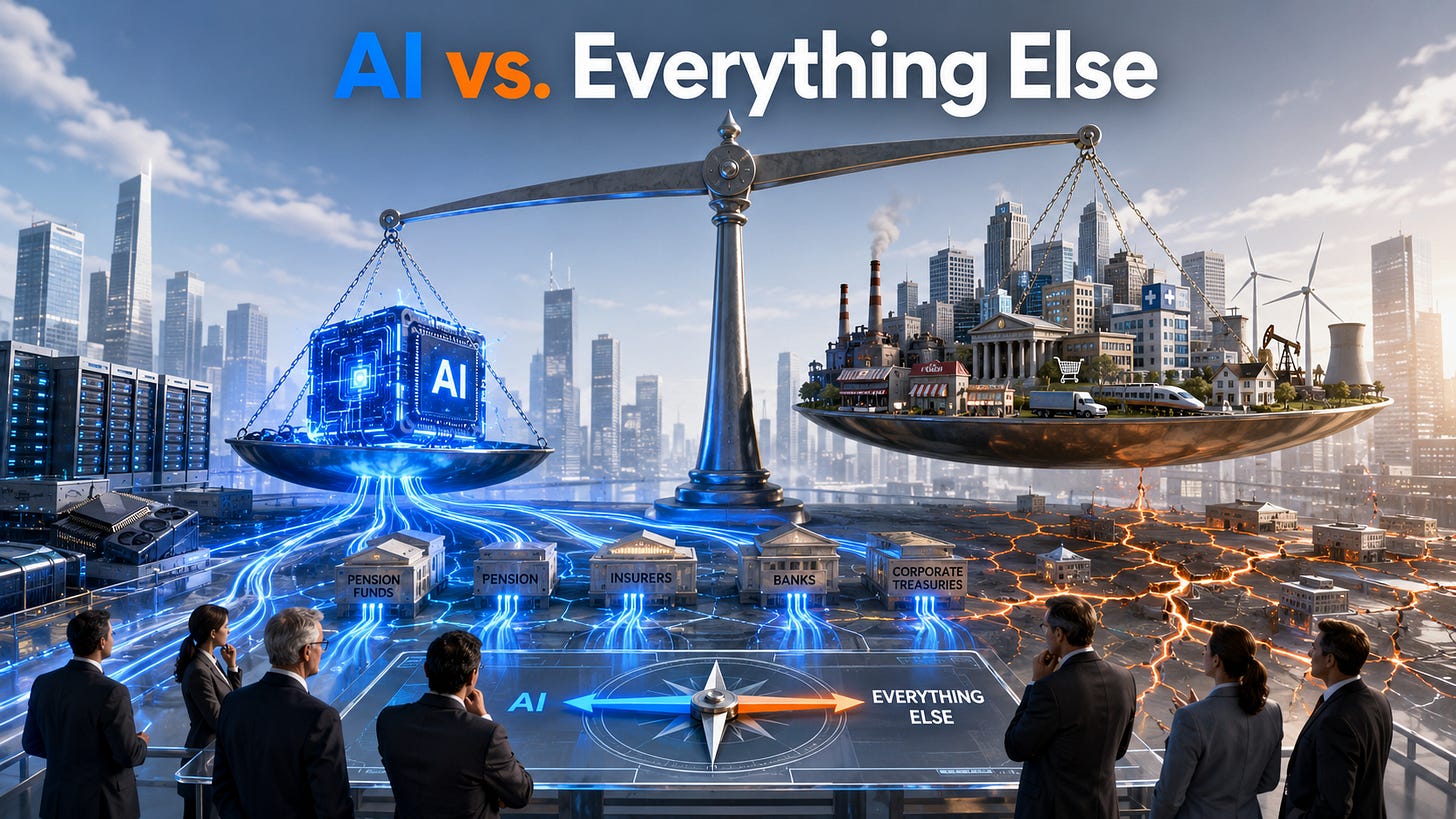
“The new 60-40 is AI vs. non-AI,” Torsten Slok, Apollo’s chief economist, wrote in a slide deck shared with investors this month. He wasn’t describing a trend. He was declaring the decades-old stock-bond portfolio framework obsolete.
The numbers back the claim more than the framing suggests. Nearly all net new venture capital in 2026 has flowed into AI companies, and AI infrastructure now accounts for close to half of all net new investment-grade bond issuance, meaning debt markets, not just equity markets, are now structurally exposed to one theme. Recent bond offerings from Oracle and SpaceX have drawn lukewarm investor reception, an early sign that even well-capitalized issuers are testing the limits of the market’s appetite.
The exposure runs wider than anyone holding AI stock directly. When credit markets concentrate this heavily around a single narrative, the risk transmits through pension funds, insurers, and corporate treasuries that never made an explicit bet on AI at all.
Why it matters: Whether or not you run a technology company, your capital costs, your insurer’s balance sheet, and your pension fund’s returns are now more correlated with AI sentiment than at any point since the dot-com era. Model that exposure explicitly. Don’t assume you’re insulated just because your business isn’t AI.
Would any of these three stories have made news five years ago? A viral internal memo, sure. A pay perk, maybe. But an economist rewriting the 60/40 rule because one sector got too big to diversify away from — that’s not a trend piece, that’s a structural admission. AI didn’t just create new costs this year. It created new categories of cost that didn’t have names before: the compute allocation, the concentration exposure, the burnout confession as blunt instrument.