The organizational middle is vanishing — what comes next?
Get insights like this every week
Subscribe to Innovation Insights Newsletter for concise briefings on leadership, AI, and innovation.
The organizational middle is vanishing faster than the systems built to replace it. Silicon Valley companies are flattening hierarchies at unprecedented velocity — middle managers accounted for 29% of layoffs in 2024, up from 19.7% in 2018 — while the infrastructure those structures require (decision frameworks, leadership pipelines, coordination mechanisms) simply doesn't exist yet. A pattern is emerging: the gap between structural velocity and organizational capability is becoming the real constraint. Not hierarchy. Not consensus. Infrastructure.
- 🏗️ The Leadership Pipeline Crisis: Company hierarchy is being flattened — see what's replacing it
- 🤖 Physical AI's Reality Check: Why $27 billion in funding meets 90-minute battery life — and what deployment actually requires
- 🧠 The Cognitive Crisis: How 96% stress rates among younger workers expose systemic design failures masquerading as wellness problems
- ⚡ The Energy Reckoning: When AI's massive power consumption collides with 1950s grid infrastructure
Read time: 6 minutes 👇
(Upcoming) Making AI Deterministic — A Conversation with Harish Epuri, Former VP of Engineering at Autodesk
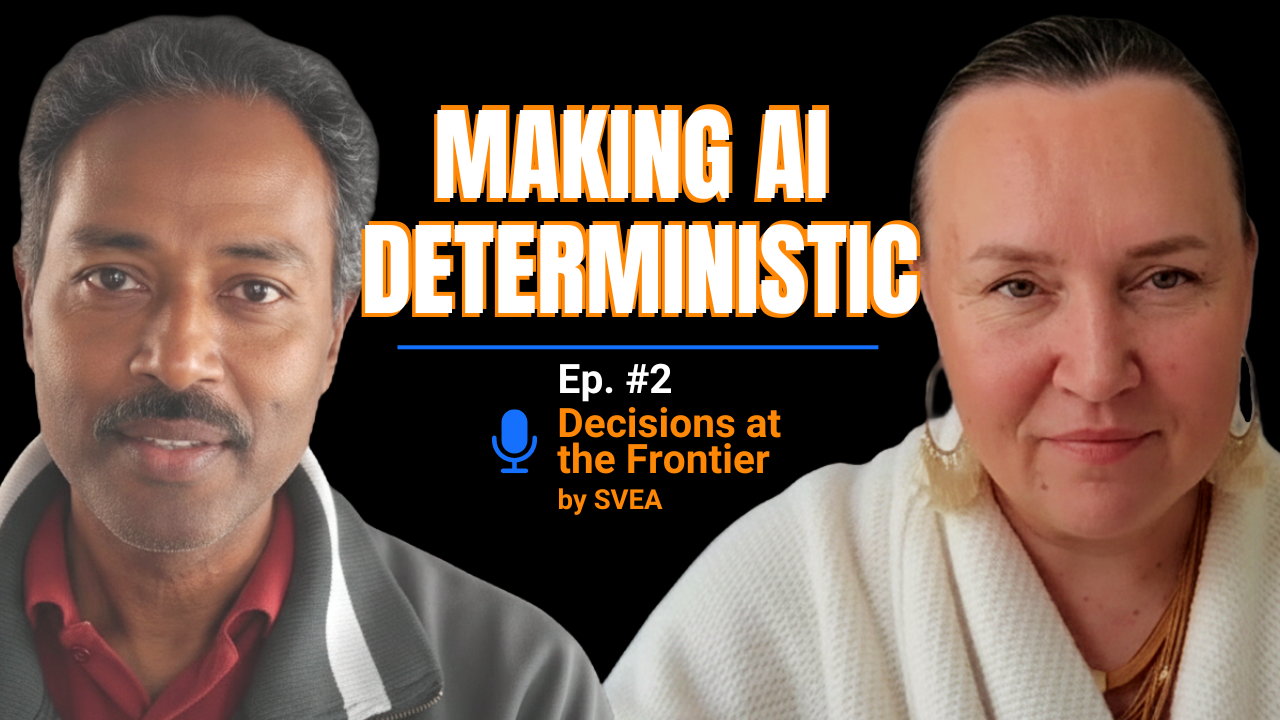
Most enterprise AI conversations still focus on capability. The harder question is what it takes to make AI reliable enough for real organizational decision-making.
Decisions at the Frontier — Live is our conversation series for senior leaders navigating AI beyond the hype cycle and into operational reality.
In our upcoming Episode 2, Dr. Victoria Mensch sits down with Harish Epuri, former VP of Engineering at Autodesk, for a candid discussion on why successful AI transformation depends less on forcing adoption and more on building trust, accountability, and environments where experimentation can scale responsibly.
In this upcoming episode, Dr. Victoria Mensch and Harish Epuri explore:
- Why enterprise AI initiatives struggle to scale
- The difference between deterministic automation and probabilistic AI
- Why trust becomes the foundation of adoption
- How leaders reduce uncertainty while still moving quickly
For leaders navigating AI implementation, this conversation reframes what operational readiness actually means.
The Organizational Architecture That's Replacing Hierarchy
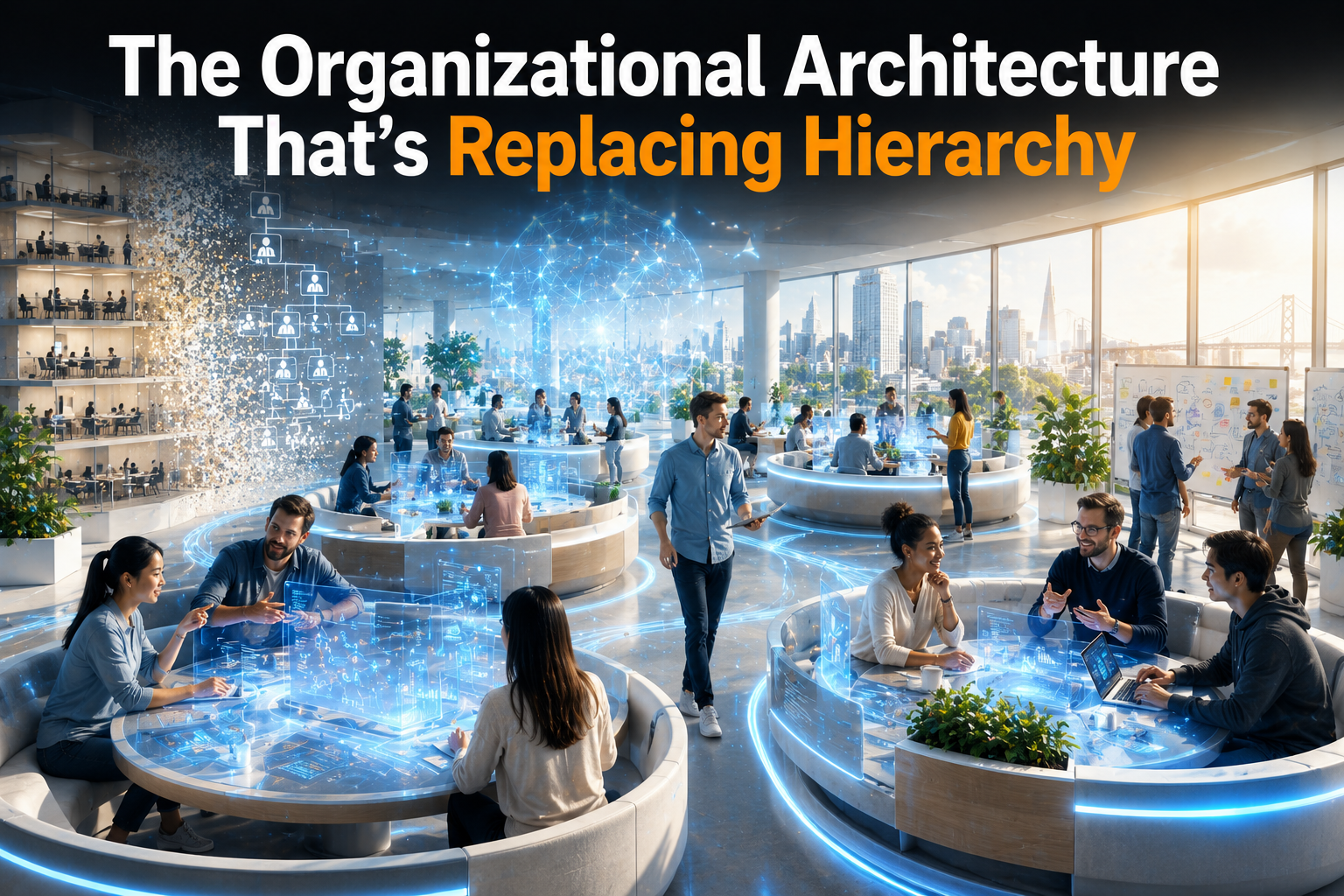
Meta introduced something they call "domain pods" in 2025 — cross-functional teams of 150-200 people operating with significant autonomy. Each pod includes engineers, designers, product managers, and AI specialists. Product decisions happen at the pod level. Escalation to division leadership only occurs for strategic shifts or resource allocation.
The pattern emerging across Silicon Valley companies reveals a fundamental shift: you can't move fast if every decision requires consensus from people who weren't in the room when the problem was identified.
MIT professor Deborah Ancona described it as an organizational problem that's always existed but now has new urgency. Companies exist in an exponentially changing environment. Traditional hierarchies were built for a world that moved more slowly.
The structural question isn't whether to flatten organizations.
It's what happens to leadership development when you remove the training ground.
Bayer CEO Bill Anderson implemented what he calls a "dynamic shared ownership" model after taking over in 2023 — cutting thousands of managers and having employees work in 90-day project networks. He framed it as a response to a fundamental absurdity: hiring highly educated, trained people and then surrounding them with eight layers of hierarchy.
But Jane Edison Stevenson of Korn Ferry identified the hidden cost: flat organizations may elevate high performers, but they frequently fall short in producing leaders capable of coordinating across an entire organization rather than just performing exceptionally well within a single vertical.
Around 36 percent of new startups worldwide will be one-person companies this year. The organizational middle isn't just thinning — it's vanishing entirely in some contexts.
Why it matters: Organizations maintaining traditional hierarchies aren't just slower — they're structurally misaligned with how innovation happens. The capability gap is widening, and those who solve leadership development without the middle-management training ground will operate at speeds competitors can't match.
Physical AI: The $27 Billion Bet That Software-First Companies Are Missing
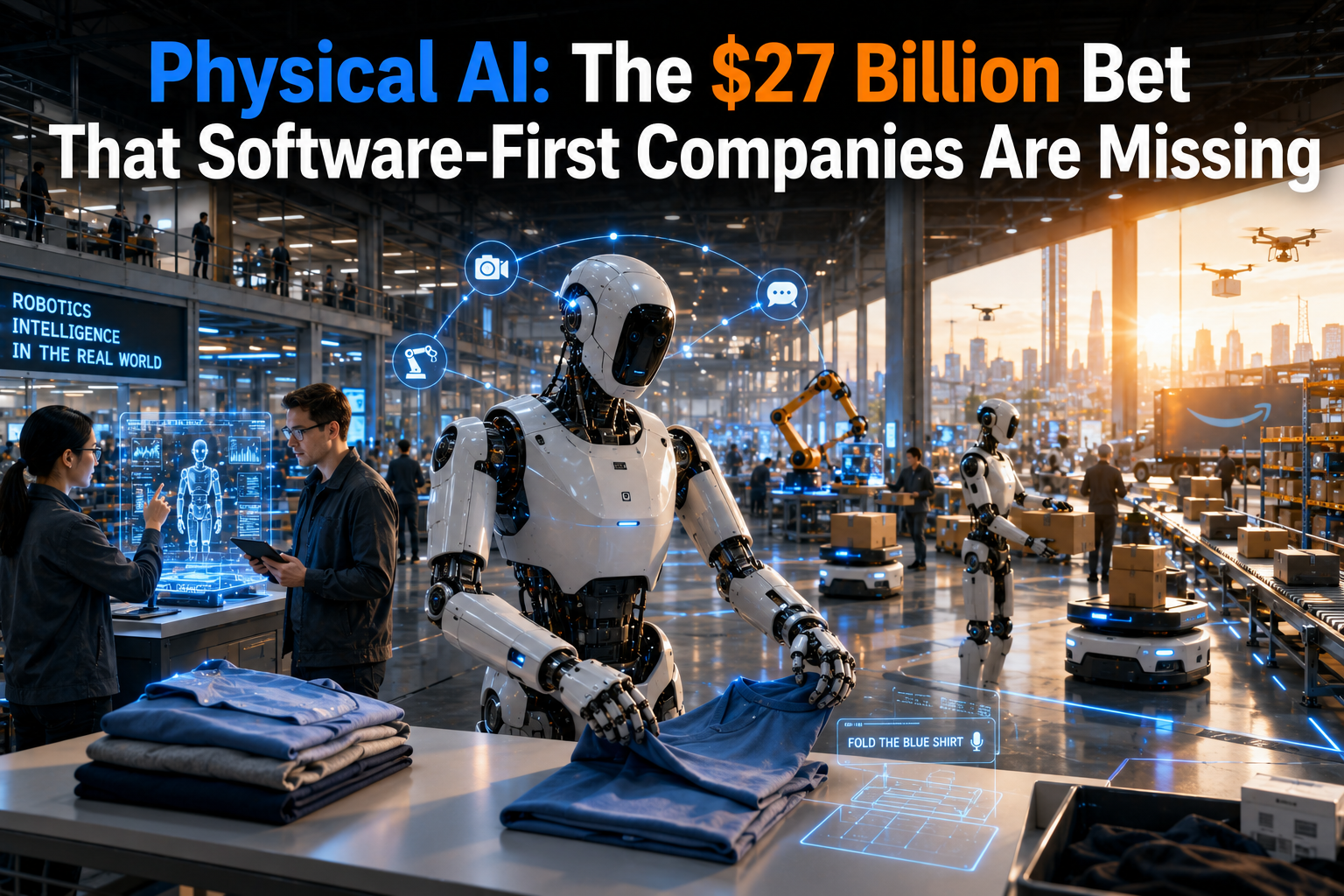
Silicon Valley robotics and physical AI startups raised $27.6 billion across 1,009 deals in 2025 — more than double the previous year — signaling that capital is flooding into embodied intelligence at unprecedented velocity. Physical Intelligence went from $75 million seed funding to a $400 million round in just eight months. Figure AI raised $1 billion at a $39 billion valuation, demonstrating that investors are betting on robots that can operate in unstructured environments.
But there's a gap between funding headlines and deployment reality. Most humanoid robots can only operate for 90 minutes on a single charge — a fundamental constraint that limits practical use cases. More critically, AI models that achieve 95% success rates in controlled lab environments drop to 60% accuracy in real-world settings where lighting changes, objects move unpredictably, and edge cases emerge constantly.
The breakthrough happening beneath the hype is the emergence of Vision-Language-Action models — AI systems that can understand natural language instructions ("fold the blue shirt") and translate them directly into physical manipulation. This represents a fundamental shift from programming robots for specific tasks to training general-purpose systems that learn through observation. China deployed 295,000 industrial robots in 2024 — representing 54% of global installations — while companies like Amazon are seeing real results: their Sequoia warehouse system improved inventory identification speeds by 75% through AI-driven robotics.
Why it matters: While software companies debate AI strategy, physical AI is rewiring manufacturing, healthcare, and logistics through embodied intelligence. The divide isn't between companies that adopt AI and those that don't — it's between organizations building around physical constraints versus those theorizing in digital-only environments. Proximity to where robots actually operate reveals implementation patterns that market forecasts completely miss.
Burnout as Systems Failure: Why Cognitive Architecture Matters More Than Workload
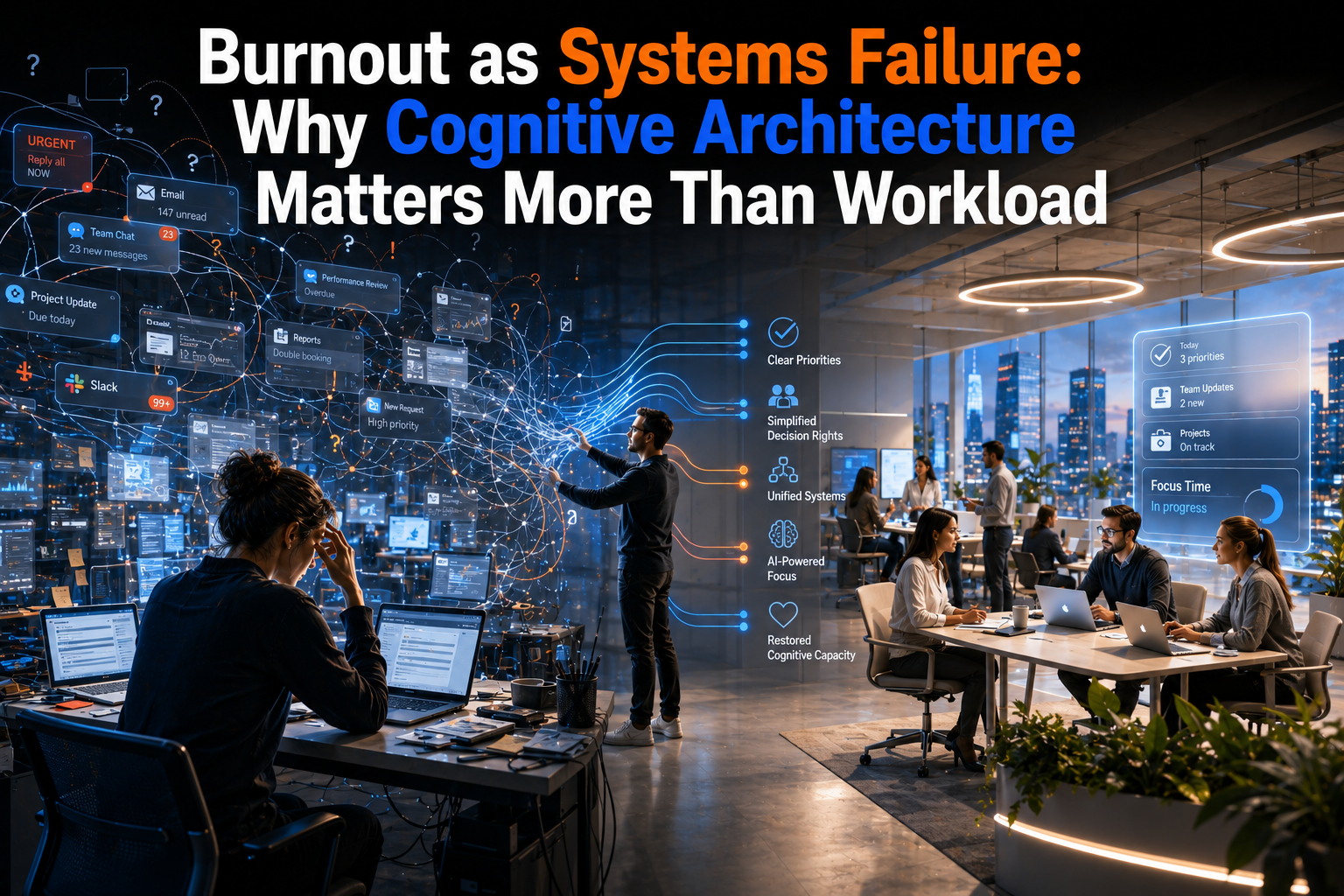
55% of employees report burnout and 72% face high workplace stress — a six-year high. But the conventional narrative has it backward: Deloitte found that cognitive overload and constant context-switching now surpass workload volume as leading burnout indicators. Workers aged 25-34 report 96% high stress rates.
82% of employees are at risk, yet fewer than half of employers have redesigned work with wellbeing in mind. The OECD reports 30% of job roles are "structurally mismatched" with digital work. Here's the paradox: when companies reduce workload without fixing cognitive friction, burnout risk drops to 5% while disengagement climbs to 23%.
The companies getting this right aren't implementing wellness programs. They're redesigning cognitive architecture — simplifying decision rights, eliminating fragmented systems that force employees to spend 60% of time navigating unclear responsibilities, and leveraging AI to restore cognitive capacity. Managers account for 70% of variance in team wellbeing.
Why it matters: Burnout isn't always a wellness problem — it's an organizational design problem. Companies redesigning cognitive architecture sustain high performance without breaking their teams. With 96% of younger workers reporting high stress, this is structural, not optional.
The AI Energy Crisis: When Data Centers Become the Fifth Largest Country
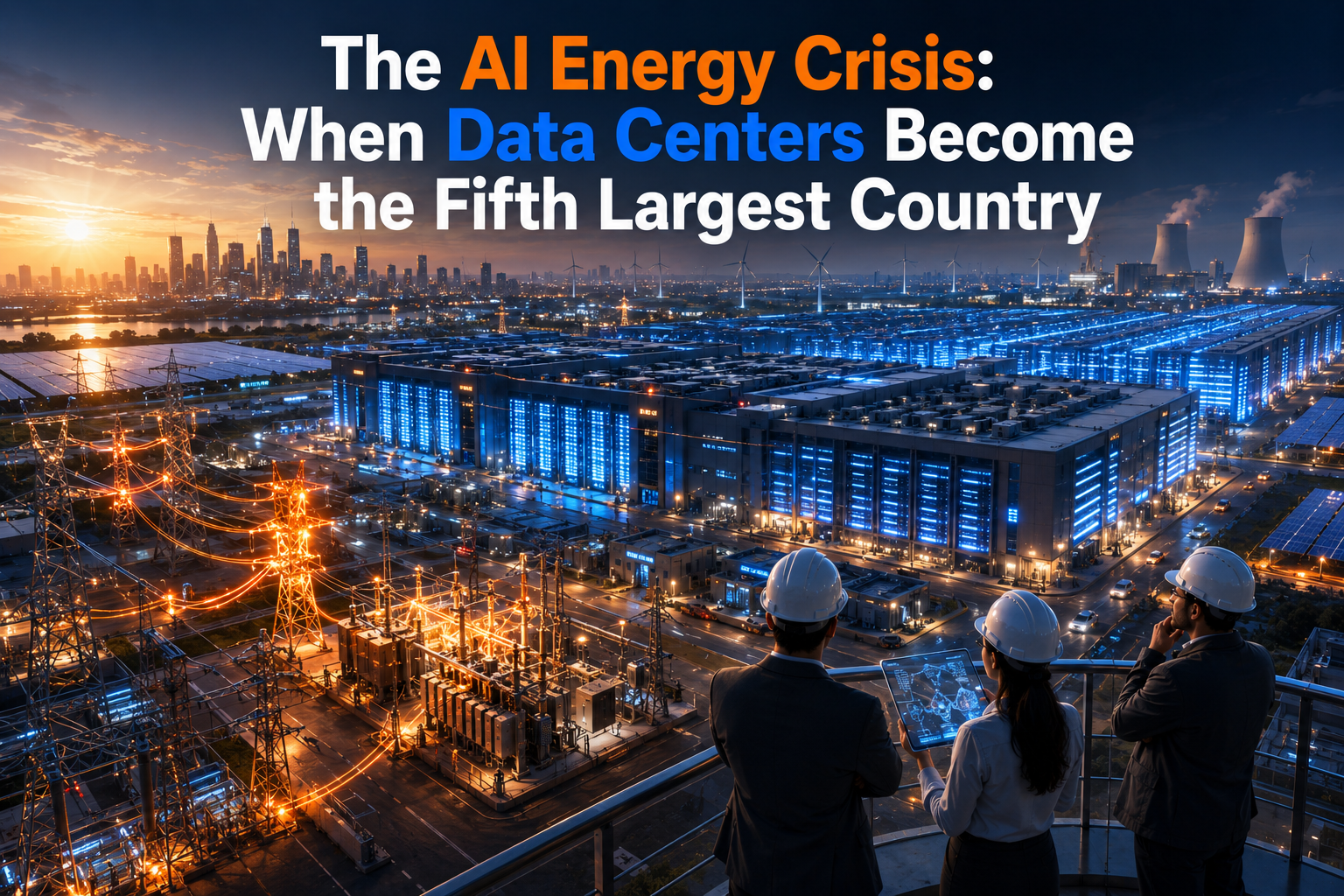
Data center energy consumption could reach 1,050 TWh by 2026 — making them the fifth largest energy consumer globally, between Japan and Russia. U.S. data centers consumed 183 TWh in 2024 (4% of national electricity), projected to hit 426 TWh by 2030 — a 133% increase. In Virginia, data centers already consume 26% of electricity. In Dublin, 79%. Tech hyperscalers are projecting $602 billion in data center spending by 2026, while U.S. utilities are ramping annual spending past $200 billion to expand grid capacity.
The metric that matters isn't sustainability anymore — it's "tokens per watt per dollar." Data centers are transitioning from cost centers to revenue generators, and 70% of the U.S. power grid (built 1950s-1970s) is approaching end of life. IEA projects global data center electricity consumption will double to 945 TWh by 2030. Virginia's Dominion Energy proposed its first base-rate increase since 1992: $8.51 per month added in 2026.
Here's the infrastructure reckoning nobody's addressing: AI is scaling faster than the energy systems required to power it. Companies are making multi-billion-dollar AI deployment commitments while underestimating true energy costs by orders of magnitude. The IEA warns of "trade-offs with other goals, such as electrification" if data center growth isn't managed. Power constraints — not computational ones — are now the threshold preventing data center growth. Organizations modeling energy consumption unrealistically risk distorted financial forecasts and stranded infrastructure assets if demand doesn't materialize.
Why it matters: The companies betting billions on AI are building on infrastructure that doesn't exist yet. When a single AI-focused hyperscaler consumes as much electricity as 100,000 households — and the larger ones under construction will consume 20 times that — energy becomes the strategic constraint, not technology. Companies who understand this aren't just buying cloud credits. They're co-investing in grid infrastructure, securing direct power generation, and redesigning AI workloads for energy efficiency before the cost curves make their deployment models economically impossible.

The Proximity Advantage: Why Distance from Implementation Creates Strategic Blindness
What's becoming clear across all four of these domains — organizational design, physical AI deployment, wellbeing systems, and AI integration — is that proximity to actual implementation reveals patterns that remain invisible from a distance.
The executives who are adapting fastest aren't the ones consuming the most content about innovation. They're the ones spending time in environments where these shifts are happening in real time, learning not just what's changing but how to operationalize those changes at scale.
That's the advantage that can't be replicated through case studies or frameworks alone.