Starbucks is building the software it used to buy — what does this tell us?
Get insights like this every week
Subscribe to Innovation Insights Newsletter for concise briefings on leadership, AI, and innovation.

Every organization racing to build, automate, or hire is running the same experiment: deploy first, verify later. Deploy first, verify later has quietly become this year's default operating mode. Speed gets rewarded immediately. The verification step gets skipped, deferred, or assumed away. The bill for that always comes due later, not never.
In this edition of Innovation Insights:
- 🏗️ Starbucks Is Building the Software It Used to Buy: Fourteen months after a vendor AI tool failed across 11,000 stores, Starbucks is betting on AI again — this time building it in-house.
- 🤖 Agents Are Entering Production Faster Than Anyone Can Authenticate Them: Enterprise software is about to be eight times more autonomous. Nobody's finished building the locks.
- 🧠 Only 6% of Managers Think New Hires Are Ready: Forty-five percent of Gen Z disagrees, and the gap is showing up in your onboarding pipeline whether you've measured it or not.
Read time: 6 minutes 👇
(Upcoming) Culture Before Crisis — A Conversation with Maxim Williams, Vice President of Global Culture & Belonging at Autodesk
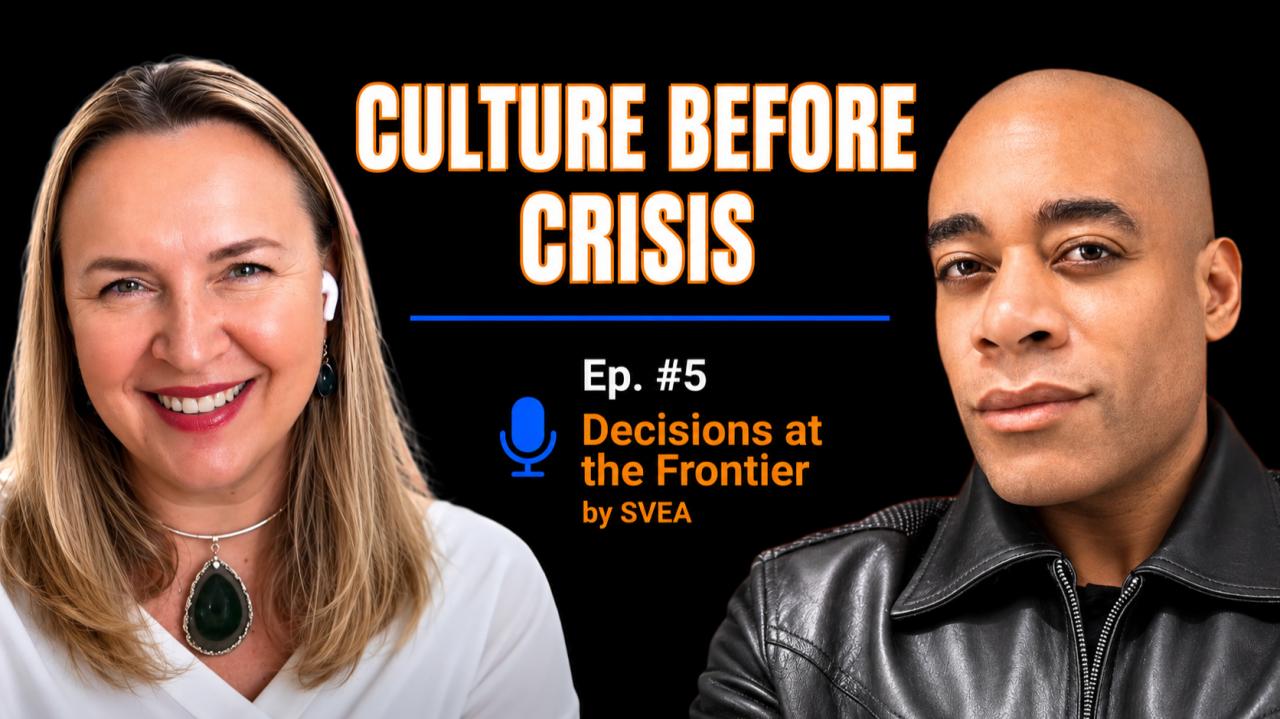
Live on LinkedIn, July 24 at 10:00 AM PST
Every organization talks about culture. Few build it before it's tested — and the leaders who wait until disruption hits to invest in it are already behind.
In Episode 5 of Decisions at the Frontier, host Victoria Mensch sits down with Maxim Williams, Vice President of Global Culture & Belonging at Autodesk, for a conversation on why culture is one of the most important strategic assets an organization can build, drawing on his leadership experience across Apple, Gap, Roku, and Autodesk.
In this episode, Victoria and Maxim explore:
- Why culture has to be built before crisis, not during it
- How learning organizations outperform during uncertainty
- The leadership principles behind innovation and belonging
- AI's impact on organizational culture and decision-making
Live on LinkedIn, July 24 at 10:00 AM PST
Starbucks Is Building the Software It Used to Buy — Fourteen Months After Its Last AI Failure

An internal Starbucks presentation reviewed by Bloomberg lays out a plan that every CIO should read twice: the company intends to replace licensed Microsoft and IBM enterprise applications with software it builds itself, using AI-assisted coding. Chief Technology Officer Anand Varadarajan pegs the prize at a $400 million annual software bill, with roughly $30 million coming out of the enterprise technology budget this fiscal year alone.
The context makes it sharper. In September 2025, Starbucks deployed NomadGo's inventory AI across 11,000 stores on a promise of 99% accuracy and counting up to eight times faster than a human. By May 2026, an internal newsletter retired the entire program — the system confused milk varieties and missed products on shelves, and baristas went back to counting by hand.
Same company, same CEO, fourteen months later, now betting on AI again — but building rather than buying. The distinction matters more than the technology. NomadGo was a vendor promise Starbucks could not inspect. Internal tools built against its own operational reality are a different class of risk, and a different class of asset.
Gartner has projected that by 2028, 40% of large enterprises will replace at least one major SaaS application with an internally built, AI-generated alternative. Starbucks is simply early and loud about it.
Why it matters: Your build-versus-buy analysis was last recalculated when custom development meant eighteen months and a dedicated team. That assumption is stale. Run the numbers again on your three largest software contracts before renewal — and if you are the vendor, assume your largest customers are already running them.
Agents Are Entering Production Faster Than Anyone Can Authenticate Them

Gartner's projection is the number to hold: 40% of enterprise applications will carry embedded agents by the end of 2026, up from under 5% a year ago. That is an eightfold change in the population of software that can take an action without a human initiating it.
The vendor response this month tells you what broke first.
- Entrust launched a co-development program focused on agent identity, authorization, and cryptography.
- Alation announced a governed layer linking data, dynamic context, and agents so their decisions can be traced.
- 1Password shipped credential-safe browsing that lets agents log into sites without exposing credentials to the model.
Three separate companies solving the same problem in the same month signals a gap the market has already priced.
The gap is authentication and audit. Identity systems were designed around humans who log in, act, and log out. Agents hold persistent credentials, chain actions across systems, and operate at machine speed — which turns weaknesses in identity and access management into high-impact incidents quickly.
Most organizations know how many employees have admin rights. Very few can say how many agents do.
Why it matters: Your access review process assumes a human on the other end of every credential. Run one query this quarter: how many non-human identities in your environment can write to production, and who approved each one? If nobody owns that list, the eightfold increase arrives on top of a blind spot.
Only 6% of Managers Think New Hires Are Ready. 45% of the New Hires Disagree.
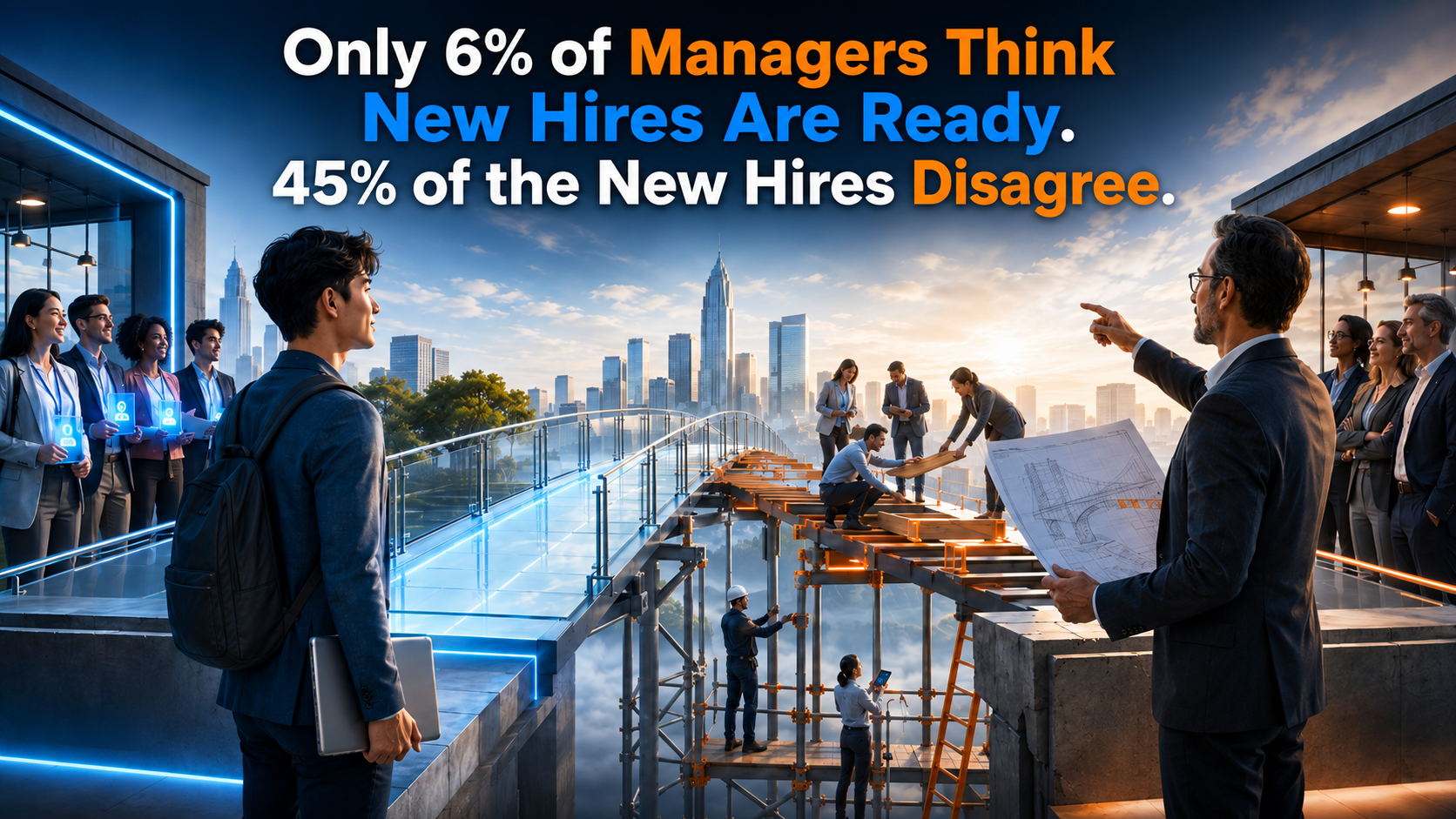
A new Chartered Management Institute report, published to mark Youth Employment Week, contains a perception gap wide enough to reframe how you think about your entry-level pipeline. Forty-five percent of eighteen-to-twenty-four-year-olds believe they arrived in the workforce equipped with the skills needed to succeed. Only 6% of managers say those same recruits demonstrate that readiness in practice.
That is not a small gap in self-assessment. It is two groups operating from almost entirely different pictures of the same population, and neither side is likely to say so directly — young hires won't volunteer that they're underprepared, and managers rarely tell a new employee outright that the gap is this wide.
CMI frames the fix as shared responsibility rather than a talent-pool complaint: government, educators, and employers each hold a piece of workplace readiness, and treating it as somebody else's problem is why the gap persists. The data was gathered in the UK, but the underlying dynamic — a generation confident in its preparation, evaluated by managers who see something different — is not a UK-specific phenomenon.
Why it matters: If your onboarding and early-career development assumes new hires arrive with the operational judgment your managers expect, this gap says that assumption is wrong for the vast majority of them. Build the skills gap into onboarding design rather than discovering it six months in through a disappointed manager.
Three very different stories, one shared mechanic. Starbucks is deploying code it built faster than it can be sure it works. The enterprise software market is deploying autonomy faster than it can authenticate who holds it. And companies are deploying Gen Z into real responsibility faster than anyone has checked whether the skills are actually there. None of these are AI failures, talent failures, or vendor failures in the way they'll get described after something breaks. They are verification failures, arriving on a deployment timeline that outran them by months.
The organizations that will separate themselves today are not the ones deploying fastest. They are the ones who built a verification step into the deployment timeline instead of treating it as the thing you do after something goes wrong.