Studies Show: AI May Weaken Conviction, not Necessarily Thinking
Get insights like this every week
Subscribe to Innovation Insights Newsletter for concise briefings on leadership, AI, and innovation.

The most interesting leadership stories this week are not about adoption, disruption, or transformation. They are about leaders separating the story they were sold from the mechanism that actually works. A study of AI use found that heavy reliance does not necessarily reduce cognitive ability, but it can weaken people's confidence in their own reasoning. The largest four-day workweek study found that the shorter schedule works only when companies redesign the work underneath it. And AstraZeneca CEO Pascal Soriot is telling investors that AI's real value in pharma is productivity improvement, not the sweeping transformation many have priced in. The pattern is clear: the leaders who win now are the ones willing to name what's actually happening.
🧠 AI May Replace Conviction Before It Replaces Work: New research suggests the bigger risk is not cognitive decline, but confidence erosion.
🏗️ The Four-Day Week Finally Has the Data: The schedule works when it forces operating-model redesign, not when it is treated as a perk.
🤖 AstraZeneca CEO Names AI's Real Job: Pascal Soriot is reframing AI as productivity improvement, not instant transformation.
Read time: 6 minutes 👇
Click to watch now ^
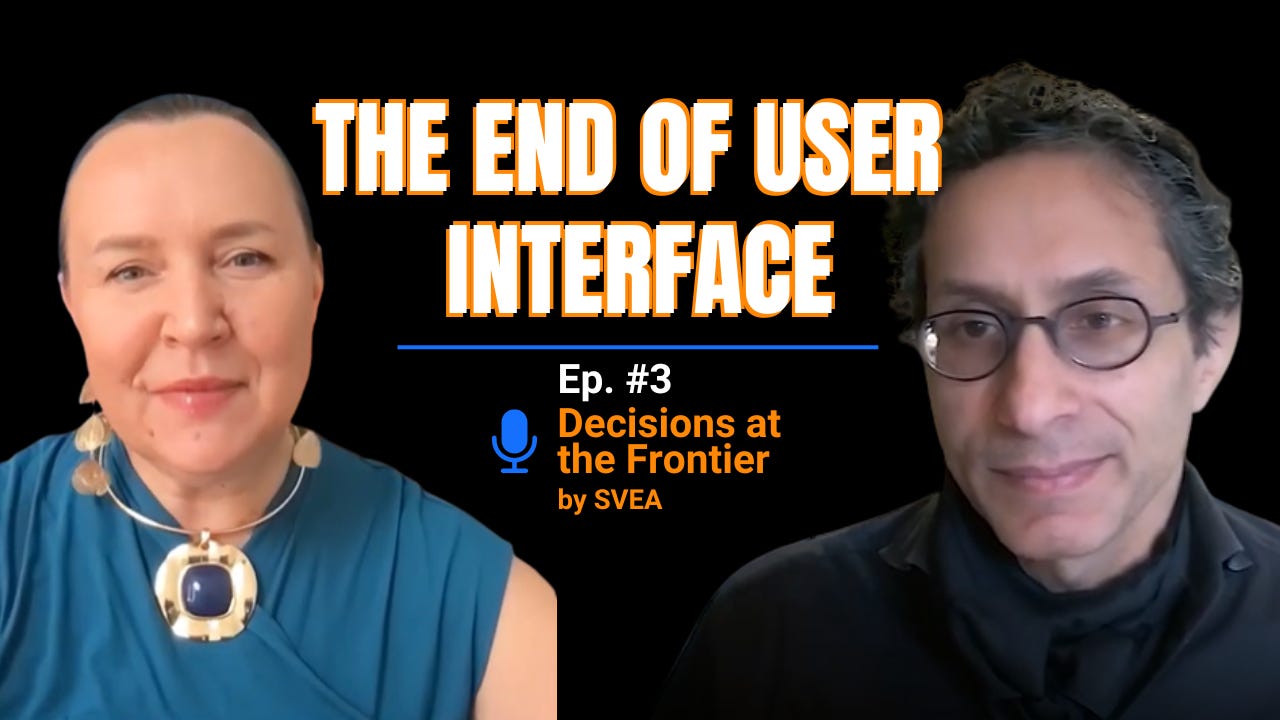
Most AI pilots never leave the building. Decisions at the Frontier is SVEA's podcast for senior leaders who are past the hype and trying to make real decisions about AI.
Episode 3 features Shiraz Cupala, VP of Product at Microsoft Teams, who has spent 25 years building products at the intersection of technology and human experience. The conversation goes deep on why great product design and actual adoption are two entirely different problems — and what it takes to close the gap.
In this episode, Dr. Victoria Mensch and Shiraz Cupala explore:
-
Why users' stated needs and actual behavior routinely diverge — and how experienced product leaders design for that gap
-
What the history of computing interfaces reveals about where AI-driven products are heading in the next three to five years
-
How to structure teams so breakthrough innovation doesn't get crushed by the pressure to maintain what already works
-
Why retention among a handful of committed users matters more than broad adoption numbers in early-stage product development

A recent study published by the American Psychological Association tested how people perform on simulated work tasks with commercial AI tools available today. The surprising result was not that heavy AI users became less intelligent or lost measurable cognitive ability. The sharper finding was that reliance on AI weakened people's confidence in their own reasoning and reduced their sense of ownership over the ideas they produced.
That difference matters. The common fear is that AI will make people less capable. But for leaders, the more immediate risk may be that AI makes people less willing to trust their own judgment. A strategy drafted with AI can be useful. A leader who cannot defend that strategy without the tool is exposed. In high-stakes environments, confidence is not a personality trait. It is part of the job.
Executive work depends on the ability to hold a line under pressure, challenge consensus, interpret ambiguity, and make decisions without perfect information. If AI becomes the first voice in the process, the human contribution can quietly shift from reasoning to approval. The output may still look polished, but the internal ownership thins. Over time, people may become more deferential to fluent machine reasoning, even when the machine is wrong or incomplete.
The issue is not whether leaders should use AI. They should. The issue is sequence. If the model supplies the reasoning before the human has formed a point of view, the tool is not augmenting judgment. It's preempting it.
Why it matters: It's not only critical thinking that we need to protect. It's also conviction. Build friction into AI-assisted decisions by requiring people to state their reasoning before they see the model's recommendation. If your best people are starting to caveat their own judgment against the AI's, you may be training confidence out of the organization.

The largest controlled study of the four-day workweek tracked 2,896 employees across 141 companies in six countries for six months. The results were strong: lower burnout, higher job satisfaction, better health outcomes, and no broad productivity collapse. The number executives should pay attention to is 90% — the share of participating companies that chose to continue the model after the trial ended.
But the finding that matters most is not that people liked working fewer days. It is that the shorter week worked only when companies changed how work happened. Organizations that simply announced “Fridays off” without redesigning meetings, communication norms, decision rights, and workload expectations saw weaker results. The schedule alone was not the intervention. The operating model was.
That distinction matters because the four-day week is often debated as a culture perk or a recruiting tactic. The data points somewhere more serious. A shorter week can force leaders to confront the waste embedded in the current system: recurring meetings with no owner, slow approvals, unclear priorities, and work that expands because the calendar allows it to expand. The successful companies did not compress five chaotic days into four. They used the trial to decide what work deserved to exist in the first place.
The same lesson applies well beyond work schedules. Many organizations are trying to improve performance by changing the visible artifact — the policy, the tool, the benefit, the mandate — while leaving the system underneath untouched. The four-day week shows the opposite logic. Change the system, and the visible artifact can work.
Why it matters: If you are considering a shorter-week pilot, do not start with the calendar. Start with the operating model. The companies that treat this as a scheduling announcement will get worse results than the companies that use it as a forcing function to remove friction, clarify priorities, and redesign how decisions actually get made.

AstraZeneca CEO Pascal Soriot recently gave investors a more grounded explanation of AI's role in the pharmaceutical industry. His framing was not that AI will instantly reinvent the company or produce transformation-grade returns on command. It was that AI can improve productivity in research, help design new medicines faster, and support better decisions in expensive, expert-driven workflows.
That may sound modest compared with the language surrounding AI investment over the last two years. It is also more useful. In pharma, the work is complex, regulated, scientific, and dependent on human judgment. AI can accelerate parts of that work, reduce some forms of inefficiency, and improve the quality of analysis. But that is not the same as replacing the underlying expertise or turning a research organization into an overnight AI company.
This is the gap many CEOs are now facing. Boards and investors have approved AI roadmaps written in the language of transformation. Operators are often delivering something narrower but still valuable: productivity gains inside specific workflows. The danger is that real progress starts to look like underperformance because the original promise was inflated.
Soriot's move is notable because he is recalibrating expectations before the gap becomes a credibility problem. That is a leadership act. He is protecting the real value of AI by refusing to describe it in terms that the business cannot operationally defend. In a market where “AI transformation” has become a default phrase, saying “productivity improvement” may be the more disciplined position.
Why it matters: Your AI investment case is probably written in the language your board, investors, or market wanted to hear. If the operational reality is productivity improvement, name that clearly. The cost of recalibration is short-term discomfort. The cost of not recalibrating is a strategy that quietly fails against promises it should never have made.

Across all three stories, the same pattern appears: the visible change is not the real change. The four-day week is not about the calendar. AI in pharma is not about transformation language. AI-assisted work is not only about faster output. The real work is underneath — in operating models, expectation-setting, decision discipline, and human ownership.
For senior leaders, this is the practical challenge of 2026. Do not defend the pitch because it sounded good when the initiative was approved. Defend the mechanism. The organizations that make progress now will be the ones willing to ask what is actually producing value, what is only producing momentum, and what needs to be renamed before it becomes a strategy problem.