The AI Boom Has a Business Model Problem

AI has made work faster. That was the easy part.
The harder part is arriving now, in three places at once: how expertise is priced, how infrastructure is financed, and what CEOs are willing to call transformation.
This week, the law firm behind much of Silicon Valley’s startup and venture work questioned the billable hour in public. Bond investors marked down the debt behind some of the largest AI data center projects in the US. And 400 US CEOs told KPMG that AI agents are delivering results — but only 9% call them transformational.
Different industries. Same problem: AI changes the cost of producing something long before anyone figures out how to price, finance or value it.
This week I spoke with a senior tech executive who recently addressed a room of 25 utility CIOs. Their biggest fear wasn’t the competitors they already know. It was an AI-native newcomer that could learn their business and launch at their scale — while they’re still carrying legacy processes and answering to a board.
That fear is the real story behind this week’s news. None of it is about technology. It’s about business models — and many leadership teams still treat AI as an adoption question. SVEA immersions put executives across the table from the founders, investors and operators already answering the harder ones.
This week’s signals
⚖️ Cooley’s CEO asks what clients are actually paying for
🏗️ AI infrastructure debt meets its “Darwinian moment”
📊 CEOs are getting results from AI. Few call it transformation.
Read time: 7 minutes 👇
⚖️ When AI Eats the Billable Hour, What Are Clients Paying For?

Rachel Proffitt has a simple test for the billable hour. Clients never cared that a matter took 82 hours. They cared about the result. Nobody asks how long the chef spent on their dinner — so why is legal work billed by the minute?
Proffitt is CEO of Cooley. In an October 19 Business Insider interview, she made her position clear: the danger isn’t losing billable hours. It’s failing to find new ways to stay valuable to clients.
So Cooley is building the tools that could cannibalize its own model:
With Legora and Y Combinator: a tool that lets YC founders review standard contracts without calling a lawyer.
With OpenAI: tools that help attorneys draft documents for companies heading to IPO.
With Google: an AI agent that flags confidential information and suggests redactions before court filings.
Then it moved the work outside the firm. Cooley AI is a wholly owned subsidiary, built to hire engineers and experiment at startup speed, free of the parent firm’s bureaucracy.
The logic is blunt. AI-native law firms are already promising cheaper, faster legal work. If someone is going to automate your billable hours, it is safer for it to be you.
Proffitt isn’t declaring the billable hour dead. Not yet.
The harder problem is talent. Junior lawyers learned the craft by doing the research, review and drafting that AI now handles. Cooley’s early answer is simulated cases, starting with AI-powered mock depositions. Will junior hiring slow? Proffitt says it’s too early to tell.
Why it matters
Every expertise business — consulting, accounting, agencies, engineering services — sells some version of time. When AI compresses the time, someone captures the margin: the firm, the client, or a competitor who reprices first.
And if AI absorbs the apprentice work, the pipeline that produces your future senior experts has to be redesigned on purpose. It won’t fix itself.
I saw this firsthand recently. A lead magnet I built would have taken six months, three agencies and half a million dollars when I was at the large enterprise company. It took a few hours. When the cost of producing expert work collapses like that, the price can’t stay where it was for long.
🏗️ AI Infrastructure Debt Meets Its “Darwinian Moment”

The AI buildout runs on borrowed money. Credit markets have started pricing the risk.
According to Financial Times reporting last week, bonds financing several major US data center projects — including projects linked to some of the largest tech companies — have slipped below par. Debt tied to some AI cloud providers has moved into distressed territory.
Allianz’s chief investment officer, Ludovic Subran, called it a “Darwinian moment” for data center debt: weaker projects won’t survive. Power constraints and construction delays have widened spreads. New York and Texas have imposed curbs on new data centers.
The underlying math is stark. By some industry estimates, data center owners will need more than twice as much revenue by 2030 as AI spending is currently projected to deliver.
None of this means AI demand is fading. It means lenders are separating AI’s long-term importance from whether a specific project’s cash flows can service its debt. They are also wary of circular financing — AI companies and their suppliers funding each other’s growth.
Why it matters
If you buy AI rather than build it, this still lands on you. Your cloud and AI vendors are financing capacity on assumptions that may not hold. That shows up in pricing, contract terms, and whether a provider is still standing in three years.
Before signing a long-term commitment, ask what happens to your vendor if growth comes in at half the forecast — and how locked in you are if it does.
📊 CEOs Are Getting Results From AI. Few Call It Transformation.
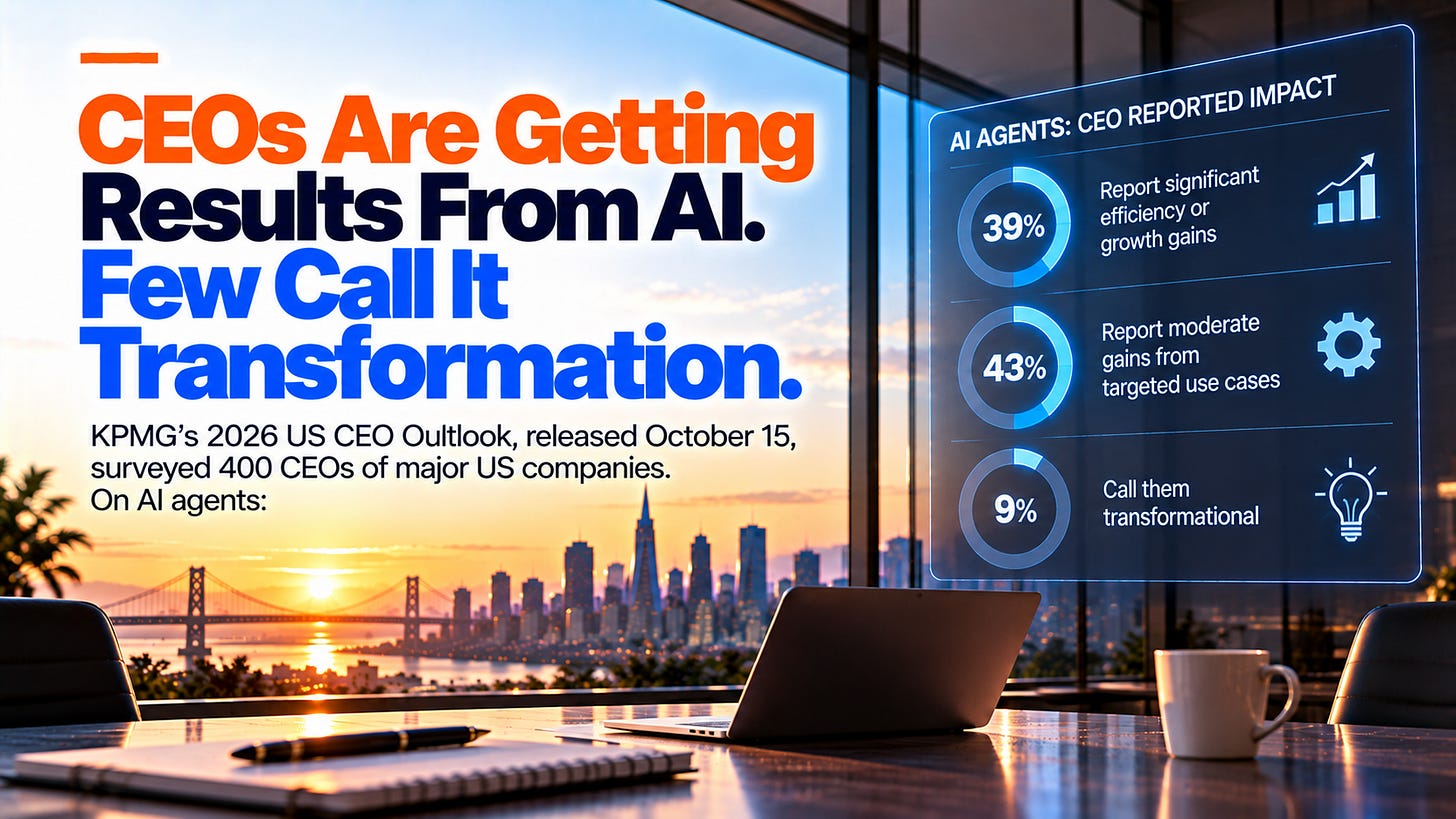
KPMG’s 2026 US CEO Outlook, released October 15, surveyed 400 CEOs of major US companies. On AI agents:
39% report significant efficiency or growth gains
43% report moderate gains from targeted use cases
9% call them transformational
That gap is the story. Most companies are using AI to run the existing business better: faster reporting, automated customer inquiries, sharper analysis. Same customers, same channels, same revenue model.
That is valuable. It just isn’t transformation, and leadership teams should stop using the word for it.
Two other findings deserve more attention than they’re getting.
Cost. 81% of CEOs believe the rising cost of AI will reshape corporate margins more than labor costs over the next five years. Half say managing the cost of implementing AI is mostly or very challenging. The labor-savings story is turning into a technology-cost story.
People. 89% expect to grow headcount over the next three years — but 60% expect growth under 5%. Meanwhile, 75% say AI has made them rethink the skills required for entry-level roles. Not mass layoffs. Not a hiring boom. A quiet redesign of the first rung of the career ladder.
The executive I mentioned earlier put it bluntly: before hiring a new AI team, look at the engineers you already have. They know your processes and where the problems are buried. Many need only one or two new skills, like writing evals or building retrieval systems, to make the shift.
Why it matters
Ask your team which outcome your AI budget is actually buying:
Operational improvement: existing work done faster or cheaper
Operating-model change: different workflows, decision rights and team structures
Business-model change: new products, revenue streams or ways to compete
All three are legitimate. But if you’re funding the first and reporting the third, your board will eventually notice.
The Thread
Cooley’s mock depositions and KPMG’s entry-level finding point at the same blind spot. AI is quietly absorbing the work that used to train the next generation of experts — and almost nobody is budgeting for the replacement.
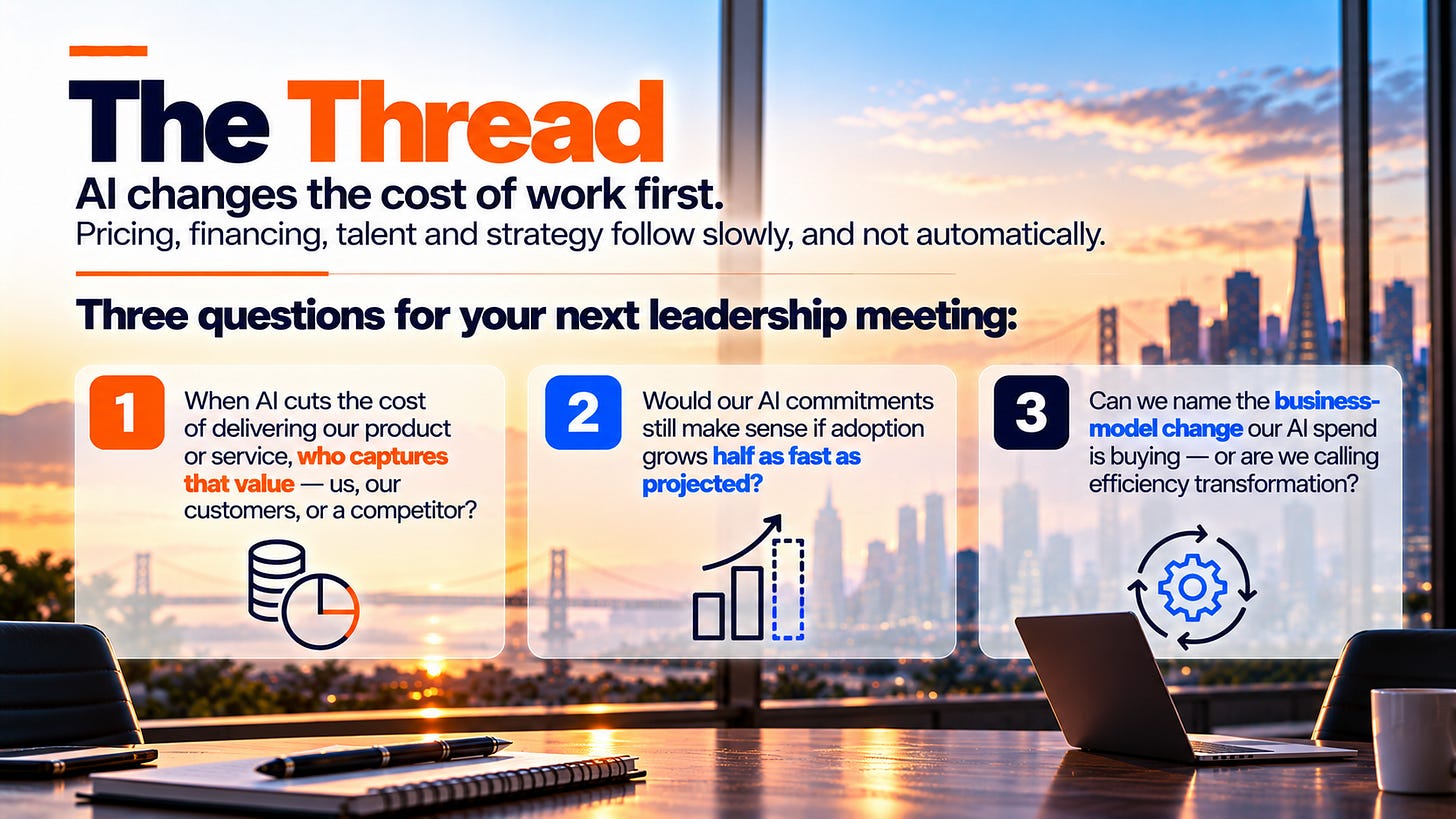
That is the pattern across all three signals. AI changes the cost of work first. Pricing, financing, talent and strategy follow slowly, and not automatically.
Three questions for your next leadership meeting:
When AI cuts the cost of delivering our product or service, who captures that value — us, our customers, or a competitor?
Would our AI commitments still make sense if adoption grows half as fast as projected?
Can we name the business-model change our AI spend is buying — or are we calling efficiency transformation?
Silicon Valley Executive Academy
These questions are hard to answer from a slide deck. They get easier after sitting across from the founders, investors and operators rebuilding pricing, financing and talent models in real time.
I used to design executive programs to stay high-level and strategic. I no longer think leaders can skip the hands-on part — it’s hard to make good decisions about a technology you’ve never touched.
That’s what an SVEA immersion is: curated, in-person access to Silicon Valley’s innovation ecosystem, built around your leadership team’s actual questions. Not a conference. Not a course.
Explore SVEA Executive Immersion Programs →
Sources: Business Insider (Oct 19, 2026); Financial Times (Oct 15–16, 2026); KPMG 2026 US CEO Outlook (Oct 15, 2026).