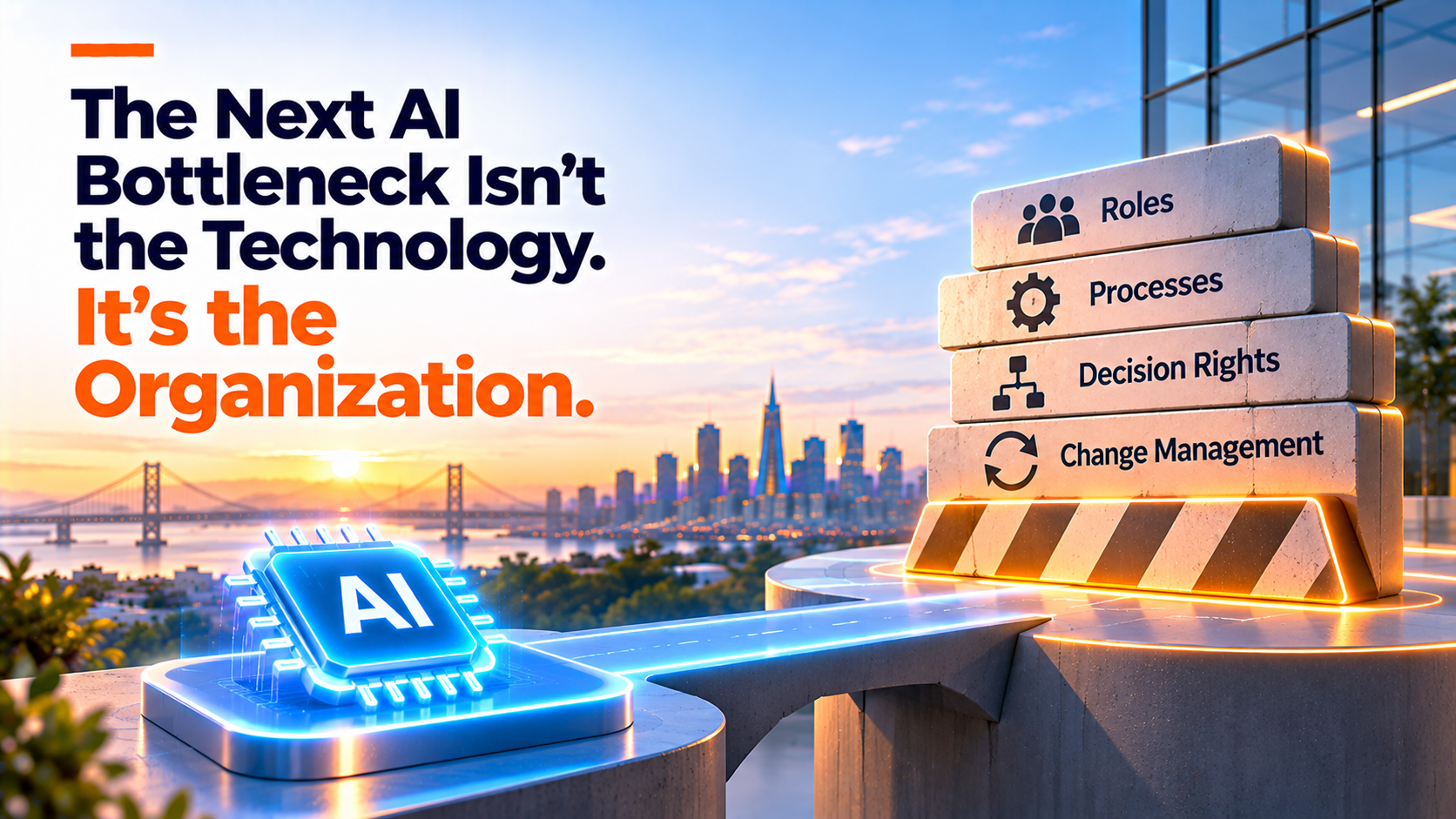
The Next AI Bottleneck Isn't the Technology. It's the Organization.
A client recently asked us to design a session for about 100 of its senior leaders around a single question: how do you lead a consulting team when AI is doing part of the delivery?
Not which model to use. Not what agents can do. The questions underneath it are about resourcing, accountability, talent development and how to evaluate performance when the work itself has changed.
A year ago, most of the AI conversations I had with executives were about capability. Now they are about the organization: who runs the system after the pilot ends, who is responsible when it fails, and how the work around it has to change.
This week’s research shows the same shift. Cognizant is building a business around operating AI for clients after deployment. Kyndryl finds that only 27% of organizations have formally updated roles around AI, even as returns rise and readiness falls. And McKinsey finds that while 80% of people say AI has made them more productive, only 37% report positive EBIT impact — a gap it traces to organizations that haven’t redesigned themselves around the technology.
Companies are learning to deploy AI faster than they are learning to operate with it.
This week’s three signals:
⚙️ Enterprise AI Is Becoming a Managed Service, Not Just a Tool. Cognizant’s new delivery model points to the next challenge: running AI reliably long after deployment.
👥 AI Returns Are Rising. The Organization Isn’t Keeping Up. Kyndryl finds roles, change management and operating foundations lagging behind adoption.
🧭 Individuals Are More Productive. Enterprises Aren’t Yet. McKinsey traces the value gap to organizations that haven’t redesigned work around AI.
Read time: 7 minutes 👇
SVEA Spotlight | Spring 2027 Enrollment Is Open
Beyond AI Knowledge. Toward AI Leadership.

Understanding what AI can do is not the same as knowing how to lead an organization through the changes it creates. That gap is what our updated program, Inside Silicon Valley: AI Leadership Playbook, is built around.
The five days move from the Silicon Valley Innovation Playbook through enterprise AI, the AI frontier and AI-driven organizational change, to each participant’s own AI Leadership Playbook and 90-day action plan. Day 4, Leading the AI-Enabled Organization, takes on this week’s problem directly: organizational redesign, changing management responsibilities, human–agent collaboration and accountability, with an executive AI lab that needs no technical background.
Dates: April 5–9, 2027, Silicon Valley, California
For: CEOs, C-suite executives, and senior business and technology leaders responsible for AI-driven transformation
Cohort: up to 20 executives
Investment: $15,000 per participant, with preferential rates for groups of three or more
Includes: executive programming, curated company engagements, accommodation, local transportation, lunches, materials and three post-program follow-up sessions
Company visits and speakers are curated based on availability and strategic fit.
Explore the updated brochure and →
⚙️ Enterprise AI Is Becoming a Managed Service, Not Just a Tool
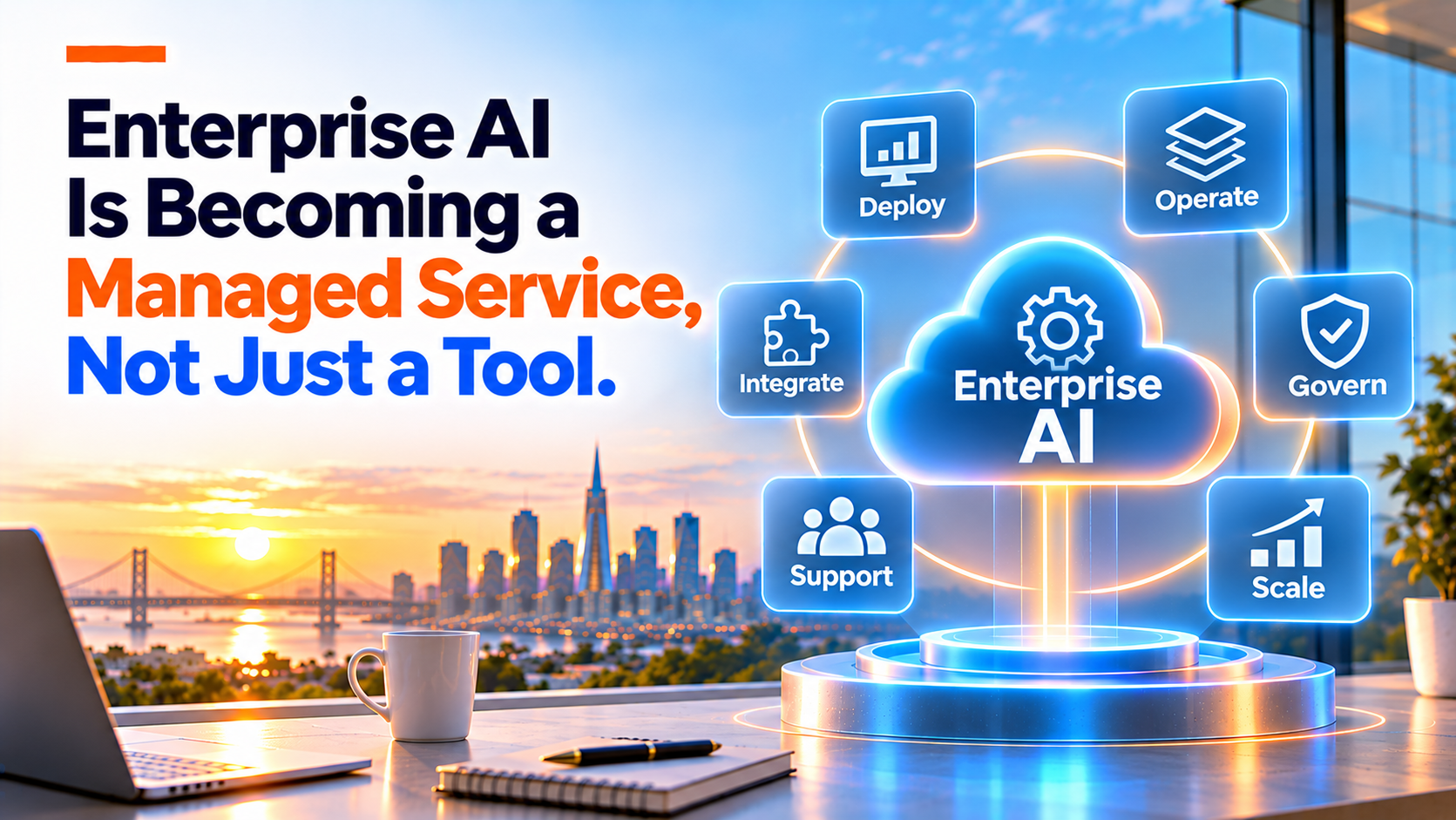
On November 10, Cognizant formed its Claude Frontier Capability Group: more than 25,000 professionals dedicated to delivering Anthropic’s Claude for clients. It also introduced a managed-services model under which Cognizant operates Claude-powered systems in production on clients’ behalf. Two weeks earlier, it announced a group of the same size for OpenAI.
The headcount is the headline. The business model is the story. For most of this AI cycle, enterprises have focused on acquiring capability: choosing models, buying licenses, launching pilots. Cognizant is selling something else — running AI as an ongoing part of the business, including maintenance, performance, integration, security and governance.
A pilot can succeed with a small team of enthusiastic specialists. A production system has to work across employees, departments, data and changing conditions. Take an AI agent in customer service. In the pilot, you measure speed and accuracy. In production, someone has to update it when policies change, catch wrong answers, handle escalations, and notice when it is cutting handling time without improving outcomes.
Cognizant reports early results, including Claude-powered shop-floor agents at a pharmaceutical manufacturer that cut downtime by 35%. These are company-reported figures, not independent results.
Outsourcing operations does not outsource accountability. A company that hands an AI system to a partner still owns the customer outcomes, the regulatory obligations and the decisions the system supports. And when competitors buy the same models from the same providers — Cognizant now runs parallel practices for both — differentiation has to come from somewhere else: proprietary knowledge, process design and how well the organization puts AI to work.
Why it matters
AI is becoming an operational capability that needs continuous management, not a project that ends at launch. Decide which AI capabilities you need to own, which a partner can run, and who is accountable for each — including who makes sure a system is still delivering value six months after launch.
Source: Cognizant, November 10, 2026 — announcement of the Claude Frontier Capability Group and managed-services model; Cognizant, October 30, 2026 — announcement of the OpenAI Frontier Capability Group.
👥 AI Returns Are Rising. The Organization Isn’t Keeping Up.
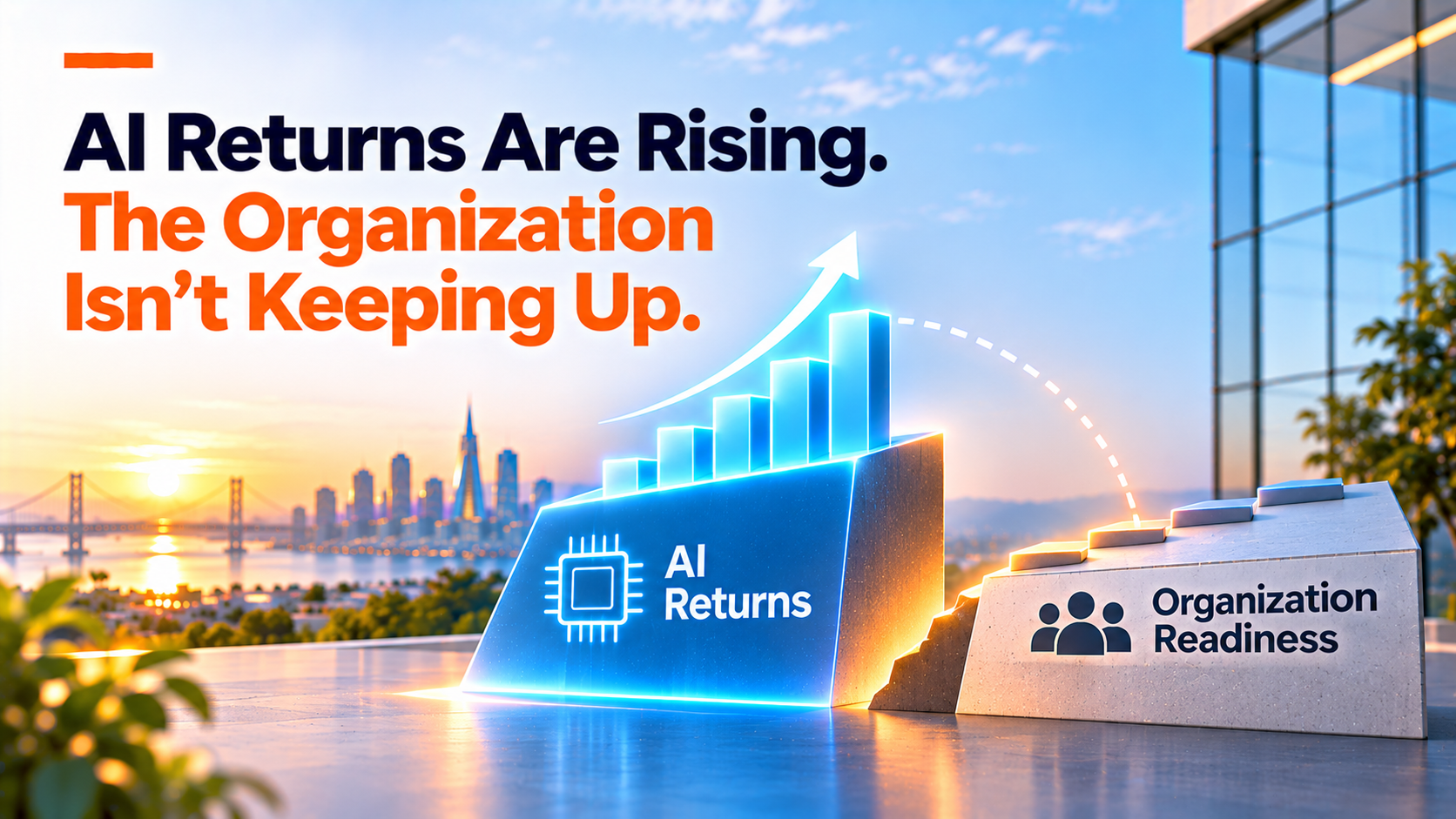
Kyndryl’s 2026–27 Readiness Report, released November 10 and based on a survey of 3,700 senior business and technology leaders in 21 countries, shows AI paying off and organizations falling behind it.
The returns are real. 64% report positive returns on AI investments, up 10 points from 2025, and 84% are deploying AI in workflows beyond pilots.
The organization is lagging:
Only 27% have formally updated roles and responsibilities around AI.
Only 29% have fully implemented change management for AI adoption.
Readiness to manage external risks fell seven points, to 24%.
Complete readiness for cyberattacks fell 11 points, to 26%.
71% call their core IT mostly or fully modernized, yet 66% of CIOs say it needs significant re-architecture to support AI at scale.
24% have seen an AI investment fail, and 21% have canceled a major AI initiative.
The roles gap is where this becomes concrete. A finance team uses AI to draft management reports, and reporting gets faster. But if nobody redefines the analyst’s job, the analyst still owns every calculation and now also validates the AI’s explanations. The manager still reviews everything. Performance is still measured on the old process. The tool is new; the job isn’t.
Kyndryl finds that organizations that have both updated roles and implemented change management are eight points more likely to report positive ROI. That is an association, not proof of cause, but it points the same way as the rest of the data: readiness depends on new responsibilities and decision rights, not just new tools.
Why it matters
Early returns don’t show whether they will last. An AI deployment can cut costs while resting on fragile integrations, unclear error handling or a single vendor. Judge AI investments on two measures: the value they deliver now, and whether the roles, infrastructure and controls exist to sustain it. For each major AI-enabled workflow, ask what work is now done differently, who reviews the AI’s output, and how performance should be measured.
Source: Kyndryl, 2026–27 Readiness Report, November 10, 2026.
🧭 Individuals Are More Productive. Enterprises Aren't Yet.
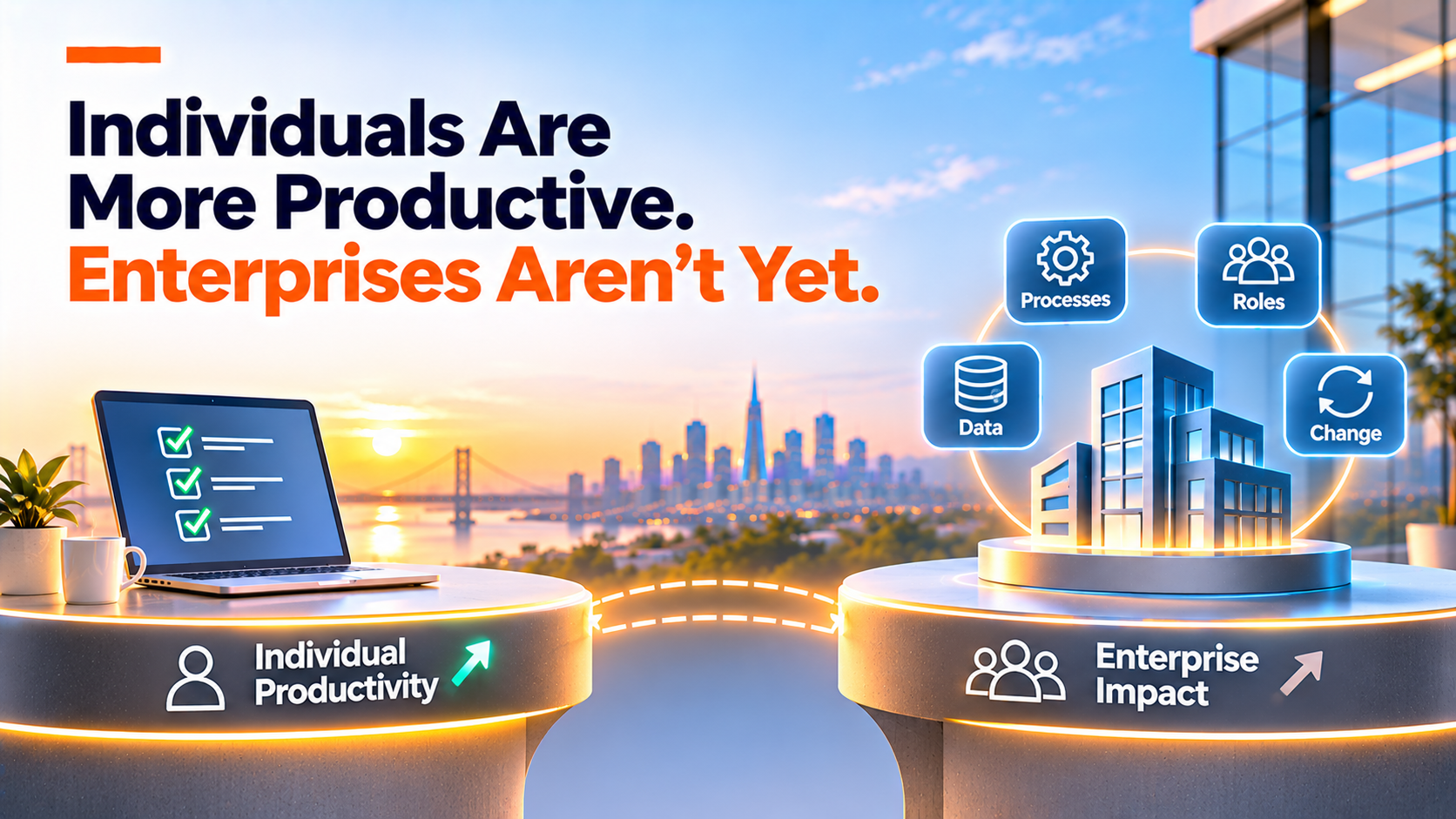
McKinsey’s recent article AI Is Changing Work. Now It Has to Change the Organization starts from a gap. In its 2026 state of AI survey, 80% of respondents say AI has improved their individual productivity, but only 37% report positive EBIT impact, and just 6% qualify as AI high performers.
What separates the high performers is organizational, not technical. Nearly three-quarters of them have substantially redesigned workflows, compared with about a quarter of everyone else. McKinsey’s readiness research shows the same split from another angle: 70% of people say they are personally ready for AI, but only 27% of leaders say their organizations are ready for the shifts it requires.
McKinsey’s prescription is to stop adding AI to the org chart and start designing around outcomes — an “orchestration chart” showing which humans and agents come together around a result, who does what, and where human judgment and accountability sit. In one product development function, pods of eight to ten people became hybrid teams of four to six supported by agents.
The article also names a cost that rarely shows up in a business case. If agents take on the entry-level work through which people build expertise, today’s productivity gain can become tomorrow’s judgment gap. Companies will need new paths to expertise, and career tracks that reward judgment and orchestration rather than team size.
Why it matters
Individual productivity gains don’t turn into enterprise value on their own. Someone has to decide where the freed capacity goes, redesign roles around it, and hold the authority to make those changes across functions. McKinsey’s test for leaders is blunt: would your teams, watching how you work, conclude that AI is actually changing how you lead?
Source: McKinsey Quarterly, AI Is Changing Work. Now It Has to Change the Organization, October 5, 2026.
The Next Phase of AI Transformation Is Organizational
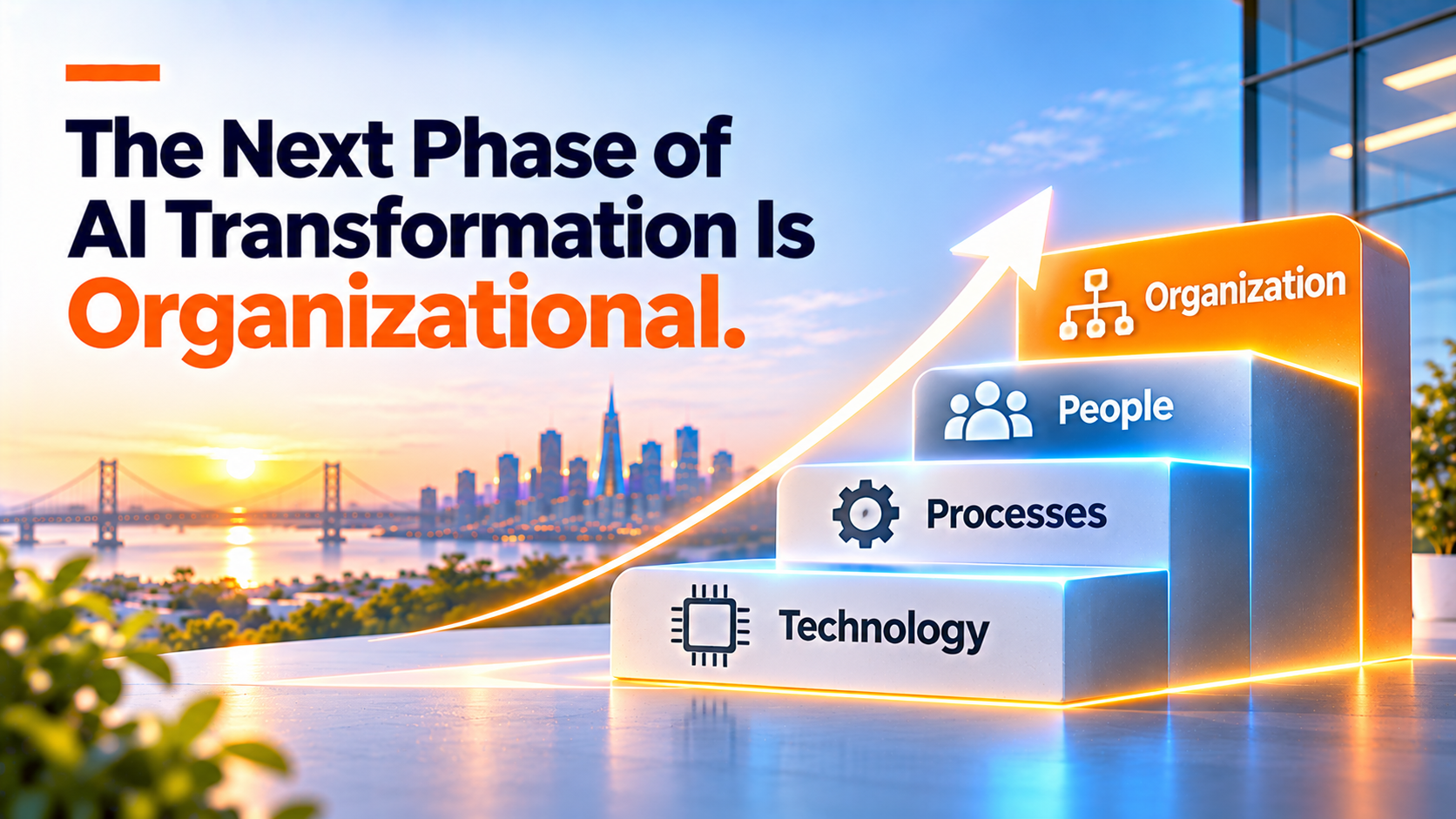
Cognizant is building a business around running AI after deployment. Kyndryl shows roles and change management lagging far behind adoption. McKinsey shows individual productivity gains failing to become enterprise value without organizational redesign.
Three shifts follow:
Treat AI as an operating capability, not a series of projects. Deployment starts the work; monitoring, maintenance and governance continue it.
Redesign responsibilities alongside workflows. AI changes who does the work, who reviews it and who owns the outcome. Roles, incentives and management practices have to reflect that.
Measure readiness alongside returns. Financial results matter, and so do infrastructure, workforce preparedness and the ability to adapt.
Three questions for your next leadership meeting:
Who owns our AI systems after deployment? Not who built them — who is responsible for their ongoing performance and business outcomes.
Which roles and management practices have we actually redesigned because of AI? If the work has changed but job descriptions, incentives and decision rights haven’t, the transformation is incomplete.
Where is our freed capacity going? If nobody decides, it disappears into more of the same work.
The client I mentioned at the top isn’t asking for a technology briefing. It is asking how to lead people through a change in how the work gets done. More and more executive teams are asking the same thing.
From Insight to Action
At Silicon Valley Executive Academy, we work with senior leaders on the strategic and organizational decisions behind emerging technologies. Our updated Inside Silicon Valley: AI Leadership Playbook brings those questions into a five-day immersion, from how AI is being built and scaled in Silicon Valley to each participant’s own 90-day plan.
Spring Cohort: April 5–9, 2027. Explore the updated brochure and apply →
Innovation Insights is published by Silicon Valley Executive Academy, exploring the intersection of emerging technology, business transformation, and executive leadership.
Originally published in Innovation Insights on Substack.