🔁 Rethinking Readiness: Who's Really Leading Change?
The leadership skills gap isn't about technology—it's about behavior. While organizations race to adopt AI tools, the real bottleneck is leaders who can't adapt how they lead. This edition explores why behavioral flexibility is the defining leadership competency of the AI era, and what the smartest organizations are doing about it.
- 🧠 Behavioral flexibility outperforms technical skill as the defining leadership trait in AI-driven organizations.
- 📊 92% of executives are unprepared for leading organizational change, according to new research.
- 🏦 Banking giants are mandating AI literacy across tens of thousands of employees.
- 👔 The CHRO is becoming the AI transformation leader organizations didn't know they needed.
Read time: less than 5 minutes 👇
The Real Leadership Gap Is Behavioral
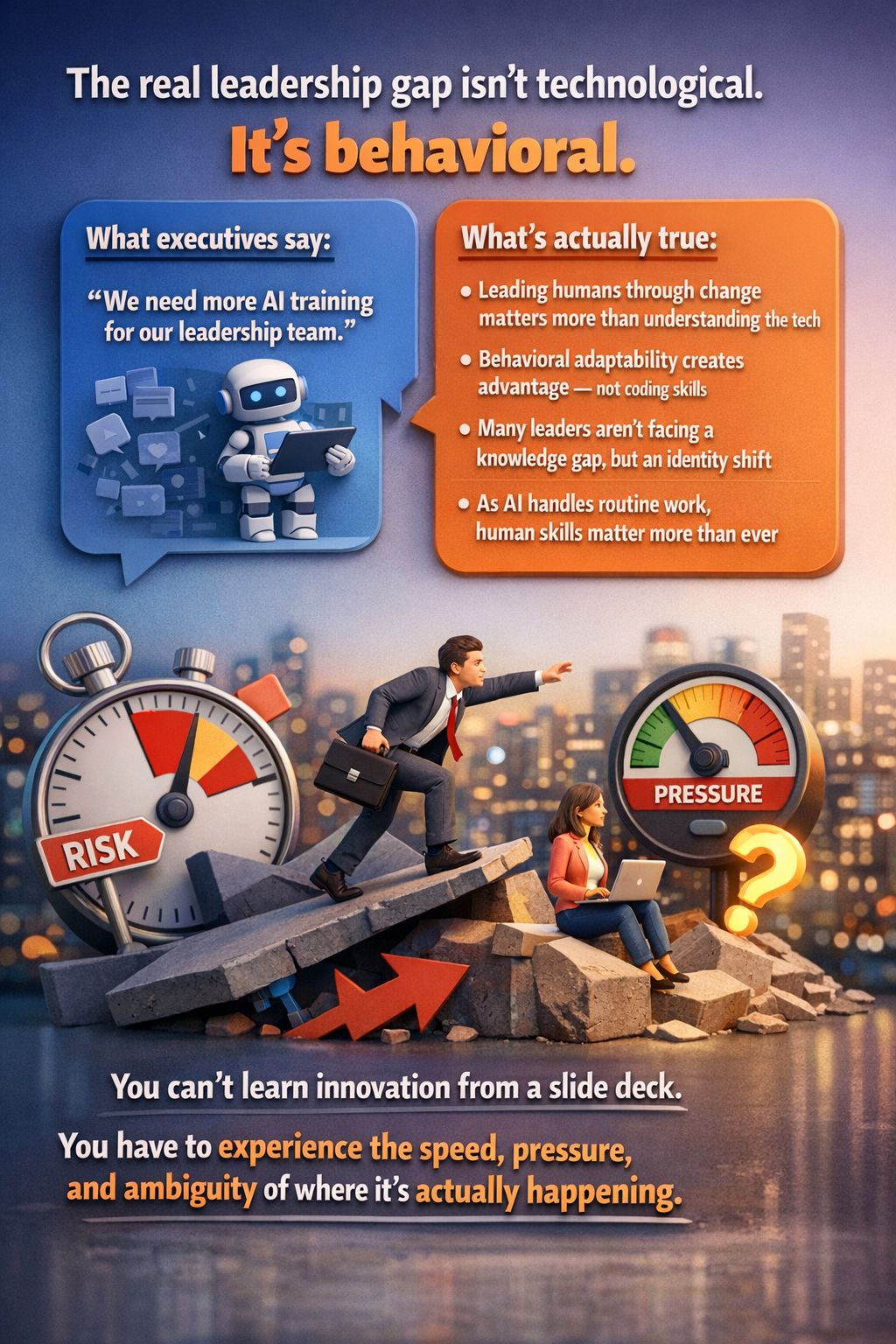
Most leadership development programs still treat AI as a technical challenge. But the organizations pulling ahead aren't the ones with the best tools—they're the ones whose leaders can adapt their behavior fast enough to match the pace of change.
Behavioral flexibility—the ability to shift communication styles, decision-making approaches, and management strategies based on context—is emerging as the most valuable leadership trait in AI-driven environments. Leaders who cling to a single playbook are being outperformed by those who can read situations and respond with agility.
Key Points:
- Technical AI knowledge depreciates rapidly; behavioral adaptability compounds over time
- Leaders with high behavioral flexibility drive 2–3x more successful change initiatives
- The gap between "knowing about AI" and "leading through AI disruption" is fundamentally behavioral
- Organizations need to shift development budgets from technical training to adaptive leadership programs
Why It Matters: The competitive advantage isn't AI adoption—it's leadership adaptation. Organizations that develop behaviorally flexible leaders will navigate disruption faster and more effectively than those focused purely on technical upskilling.
Source: SVEA
Most Executives Unprepared for Leading Organizational Change

A striking new study reveals that 92% of executives lack the skills needed to lead organizational change effectively. Despite years of digital transformation initiatives, most leadership teams remain fundamentally unprepared for the behavioral demands of guiding their organizations through disruption.
Key Points:
- 92% of executives report feeling unprepared for leading change at the pace their organizations require
- Change fatigue is accelerating—employees have experienced more transformation in the last 3 years than the previous decade
- The most effective change leaders combine emotional intelligence with strategic clarity
- Organizations that invest in change leadership capabilities see 6x higher success rates in transformation programs
Why It Matters: The gap between the pace of technological change and leadership readiness is widening. Organizations that close this gap through targeted leadership development will capture disproportionate value from their AI investments.
Source: HR Executive
Banking Giants Transform Workforce Through AI Training

Major banking institutions are making bold moves to close the AI skills gap. Lloyds Banking Group is mandating AI literacy training for all 67,000 employees, signaling a shift from optional upskilling to organization-wide capability building. This isn't just about teaching people to use AI tools—it's about creating a workforce that can think alongside AI.
Key Points:
- Lloyds is requiring AI literacy across its entire 67,000-person workforce—not just tech teams
- The program focuses on practical application, not theoretical knowledge
- Banking leaders recognize that AI fluency is becoming as fundamental as financial literacy
- Early results show improved decision-making speed and quality in teams that completed training
Why It Matters: When one of the world's largest banks mandates AI training for every employee, it signals that AI literacy has crossed from "nice to have" to "table stakes." Organizations that delay universal AI education risk falling behind competitors who are building AI-fluent cultures now.
Source: The Finanser
The CHRO Has Entered the Chat

BCG's latest research reveals a dramatic shift in who leads AI transformation. Chief Human Resources Officers are stepping into strategic AI leadership roles, bridging the gap between technology implementation and organizational readiness. The CHRO is no longer just managing people—they're architecting how humans and AI work together.
Key Points:
- CHROs are increasingly co-leading AI strategy alongside CTOs and CIOs
- The most successful AI transformations have strong HR leadership involvement from day one
- People-side challenges—culture, skills, resistance—are the primary reasons AI initiatives fail
- Forward-thinking CHROs are redesigning roles, teams, and incentives around human-AI collaboration
Why It Matters: AI transformation is fundamentally a people challenge. Organizations where the CHRO has a seat at the AI strategy table are significantly more likely to achieve lasting, scalable adoption. The future of AI leadership is cross-functional—and HR is at the center.
Source: BCG