🔍 What Fintech Investors See Coming in 2026
Three major shifts are quietly rewriting the rules of business as we know them, and the companies that miss these signals might find themselves scrambling to catch up by next year:
- 💰 VC Crystal Ball: What fintech insiders are betting their billions on for 2026
- 🤖 Marketing's AI Dilemma: Why teams are still playing it safe when everyone says go bold
- 🏠 Remote Work's Hidden Impact: The surprising ways distributed teams are changing everything
Why 30% of GenAI Projects Die After PoC — Pilot Purgatory Explained
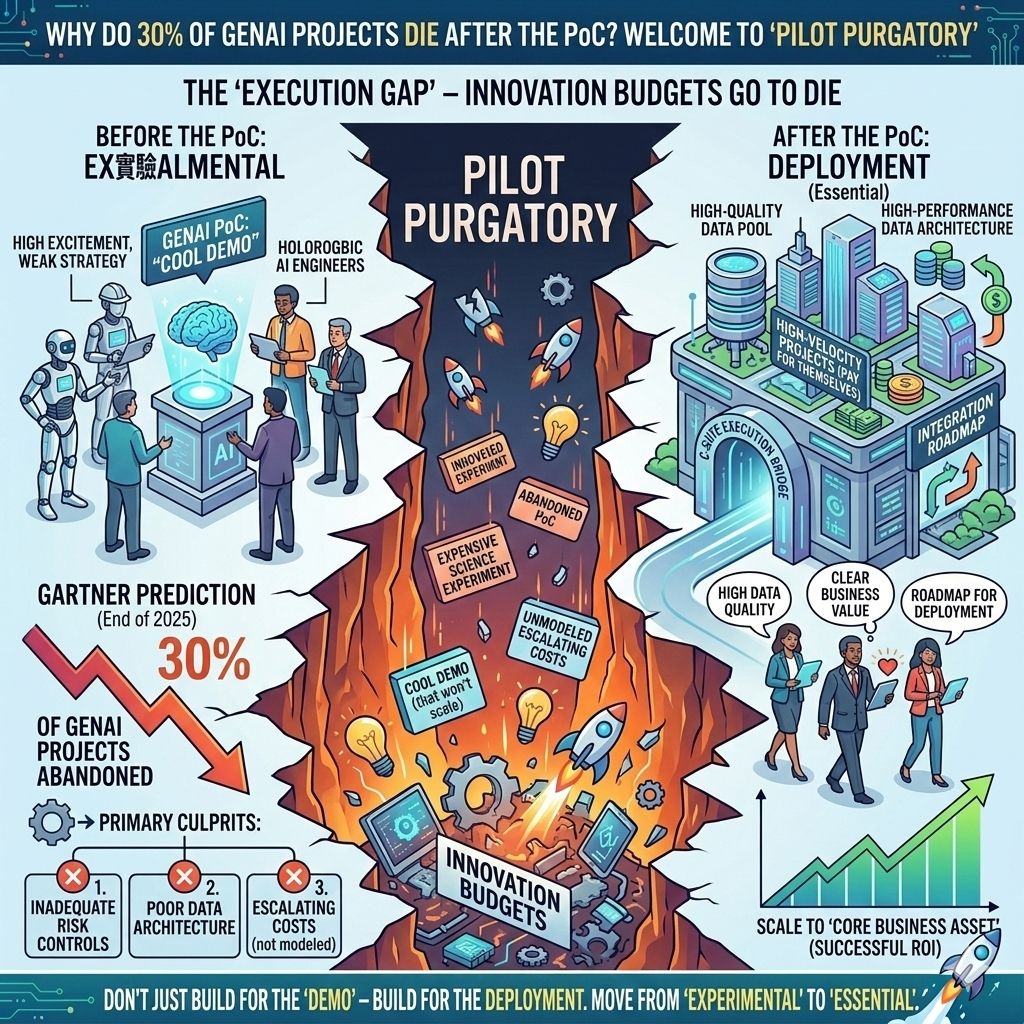
Three out of ten GenAI projects fail to survive past their initial proof of concept stage. While companies excel at launching AI initiatives, they struggle to transform promising demos into profitable business tools that actually work at scale.
Key Points:
- Technology isn't the problem—leadership teams lack understanding of AI economics and implementation costs
- Poor data quality and weak business integration plans turn promising concepts into expensive experiments
- Gartner forecasts 30% of GenAI projects will be abandoned by 2025 due to inadequate risk controls and cost overruns
Why It Matters: Without proper strategy and C-suite buy-in, your innovation budget becomes wasted spending on science projects that never deliver real business value.
Read more on svexecutive.academy →
VC Experts Reveal 2026 Fintech Investment Trends

Picture the future of fintech funding where artificial intelligence transforms how we handle money, stablecoins reshape global payments, and specialized solutions address real-world financial challenges. Industry leaders reveal the investment trends gaining serious momentum as venture capital flows toward AI-powered infrastructure, digital currency rails, and targeted trade finance solutions.
Key Points:
- AI captured 58% of all fintech VC investments in 2025, with focus shifting toward "invisible" infrastructure layers that improve payment routing, risk assessment, and settlement automation
- Stablecoin payment processing surged 87% to reach $9 trillion in volume, attracting venture attention for cross-border dollar rails
- Cybersecurity firms secured nearly $14 billion across 392 rounds as organizations build control layers for AI-driven environments
- Trade finance emerges as a specialized opportunity with VCs backing narrow-focused solutions for specific commodities and corridors
Why It Matters: These investment patterns signal a maturation of fintech funding where capital flows toward practical infrastructure solutions that solve specific problems rather than broad-brush approaches.
Read more on fintechfutures.com →
How Remote Work Has Reshaped the Professional Landscape

The pandemic transformed how we work, with remote employment now representing a fundamental shift in corporate America. Nearly one-fifth of the workforce has transitioned to remote arrangements, while 98% of workers want the option to work from home at least part-time.
Key Points:
- In 2025, 32.6 million Americans worked remotely, representing 22% of the total workforce
- Computer and IT professionals lead remote work adoption, followed by accounting, finance, and marketing sectors
- Workers aged 24-35 show the highest remote work participation, with 39% working fully remote
- 71% of remote workers report better work-life balance, though 69% experience burnout from digital communication
- 16% of companies now operate as fully remote organizations without physical offices
Why It Matters: Remote work has evolved from emergency pandemic response to permanent business strategy, offering companies access to broader talent pools while delivering the flexibility modern professionals demand.
Marketing Teams Still Experimenting Despite AI Pressure

Marketing leaders are pushing their teams to adopt AI, but most organizations lack the strategy, training, and data infrastructure needed to move beyond basic experiments. While 80% of marketers feel pressure to integrate AI into their workflows, only 6% have successfully embedded it into daily operations.
Key Points:
- Leadership teams drive 61% of AI adoption pressure, creating top-down mandates without operational guidance
- Budget constraints and privacy concerns block implementation more than lack of interest in the technology
- Teams primarily use AI for simple efficiency tasks rather than strategic analytics and decision-making
- Organizations with small analytics teams miss AI's biggest opportunity to accelerate data analysis and insights
Why It Matters: Companies that address foundational gaps in AI strategy and data readiness now will transform their marketing operations while competitors remain stuck in endless experimentation.