When AI Does the Work, What Is Leadership For?
Every day I get an AI-generated operating agenda built from my meetings and email: what’s urgent, what’s at risk, what can wait. Every week I get competitive and market briefings. None of it decides anything. The agenda ends with a short list of decisions only I can make — and more and more, that list is the job. Inside large companies, AI agents are going further: coordinating work across systems, pulling financial data and recommending operational decisions.
If AI can prepare the analysis, coordinate the workflow and recommend the next action, what should leaders actually be doing?
Judgment, strategy and accountability is the standard answer. But what does judgment look like when the system has already produced a convincing recommendation? How do you stay accountable for a workflow you no longer supervise step by step? And what happens when the data is accurate but missing the context that makes it meaningful?
Three developments this week sharpen those questions. EY lays out the shift from isolated AI tools to autonomous enterprise operations. Qlik and SAP are building ways for AI to understand what business data means. And the Financial Times reports on CEOs handing research and preparation to AI.
That is why we’re tracking this. As AI takes over coordination, information processing and oversight of execution, leaders will be judged by what they decide stays theirs.
This week’s three signals:
⚙️ The Autonomous Enterprise Is Becoming an Operating-Model Question. AI is moving from single tasks to connected workflows that coordinate decisions across functions.
🧩 AI Can Access More Business Data. Does It Understand What the Data Means? Consistent definitions and business context are becoming prerequisites for AI decisions.
⏱️ CEOs Are Delegating More to AI. What Should They Do With the Time? AI is freeing up executive time. Where that time goes is a leadership decision.
Read time: 7 minutes 👇
SVEA Spotlight | The SVEA Tech Trend Radar
The Next Leadership Skill: Knowing Which Technologies Matter to Your Business — and When
Move too slowly on a new technology and you miss the opportunity. Move too fast and you commit resources to something that isn’t yet reliable, mature or relevant to your business. Autonomous AI sharpens that tension: new capabilities are arriving faster than most organizations can evaluate them.
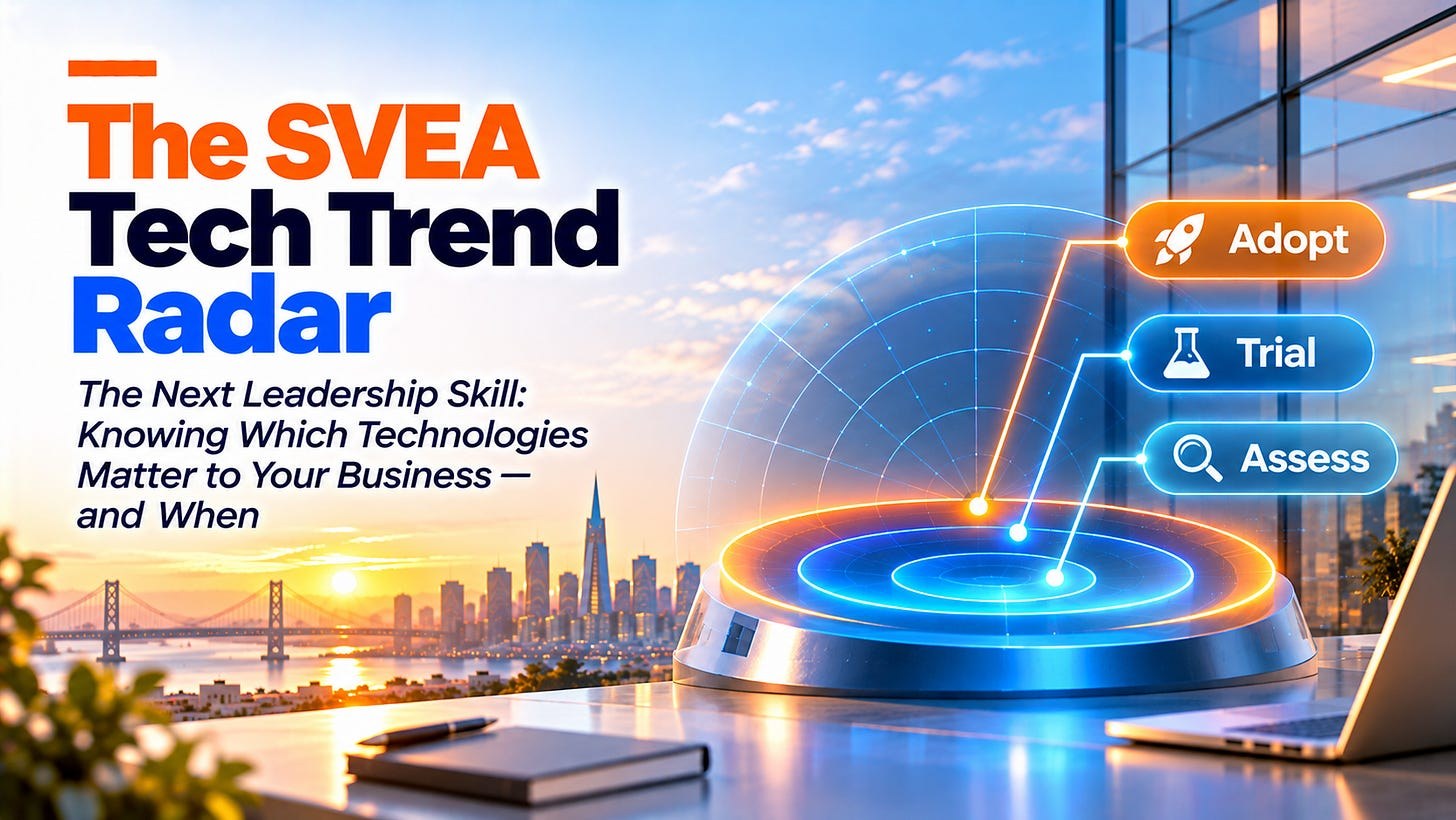
The SVEA Tech Trend Radar is a personalized executive briefing that maps the Silicon Valley trends most likely to reshape your sector, tailored to your role and industry. For each trend, it shows:
The signal: what is happening, and why now.
The gap: how executives inside Silicon Valley see the trend differently from those outside it.
Implications: what changes for your role and how the trend is resetting your sector.
Cost of inaction: for your sector and for your role.
Power map: the tech giants, startups and institutions driving the trend — and what each wants from global enterprises.
Take agentic AI. Executives outside Silicon Valley tend to evaluate it as a productivity tool that makes existing processes faster. Inside the Valley, it is treated as an organizational design question: a new kind of actor that changes how many people a workflow needs and how they are managed. Closing that gap is what the Radar is built for.
Explore the SVEA Tech Trend Radar →
The Autonomous Enterprise Is Becoming an Operating-Model Question
Most companies started with AI by automating individual tasks: drafting documents, summarizing meetings, answering routine customer questions. Useful, but the organization around those tasks stayed the same.
EY’s analysis, The Next Frontier of AI: Building Autonomous Enterprises, describes the next stage: AI agents, enterprise data and core platforms connected to run whole workflows across functions.
Take a supply chain. An AI-enabled system spots a likely inventory shortage, checks demand forecasts, compares suppliers and prepares a response. With the right permissions, it can start parts of the purchasing process itself. That changes more than speed. It changes how information moves, which decisions need a person, and how departments coordinate.
It also makes accountability harder. When several agents run a workflow, who approves their decisions? What happens when one agent acts on bad information from another? Who notices when a workflow runs smoothly but produces the wrong business outcome? EY’s answer is governance by design: monitoring, transparency, feedback loops and defined points where people step in.
EY also stresses redesign over automation. Speeding up every approval in a bloated process just makes a bad process run faster.
Why it matters
This can’t be handed to IT. Before expanding autonomous workflows, leadership teams need to settle which outcomes the system should improve, which decisions it can make alone, which actions need human sign-off, how errors get caught, and who owns the final result. That matters most where workflows cross finance, operations, procurement and customer service, because unclear ownership between functions gets harder to see once AI sits in the middle.
Source: EY, The Next Frontier of AI: Building Autonomous Enterprises, 2026.
AI Can Access More Business Data. Does It Understand What the Data Means?
An executive asks an AI assistant which customer segments are growing fastest. It pulls sales data, calculates growth rates and gives a confident answer. The numbers are correct. The conclusion may still be wrong, because one division reports revenue after discounts and returns, another uses gross sales, and a third uses a different reporting period.
Employees work around these differences through experience and conversation. AI can’t, unless the definitions are made explicit.
Two recent announcements target that problem. On October 28, Qlik launched Semantic Models, which let companies define, govern and reuse business terms, metrics and relationships across analytics and AI, including AI agents. At TechEd, SAP announced developments in its Business Data Cloud to connect enterprise data, processes and business context for AI.
The stakes rise with autonomy. A misleading number on a dashboard is a nuisance. A misleading number that triggers an automated cut in purchasing is an operational mistake.
Neither vendor solves the hard part. Someone still has to decide which definition of revenue is authoritative, who owns it, and what AI should do when data conflicts. Finance, sales and operations may need to reconcile definitions they have disagreed on for years. That takes executive authority, and no language model has it.
Why it matters
As advanced models become available to everyone, a company’s own understanding of its customers, processes and risks becomes the differentiator — but only once it’s written down in a form AI can use. Start with the decisions AI is expected to support and work backward: what information each one needs, which definitions must be consistent, and who owns them.
Sources: Qlik, Semantic Models for Shared Business Context Across Analytics and AI, October 28, 2026; SAP, TechEd 2026 announcements on SAP Business Data Cloud, October 2026.
CEOs Are Delegating More to AI. What Should They Do With the Time?
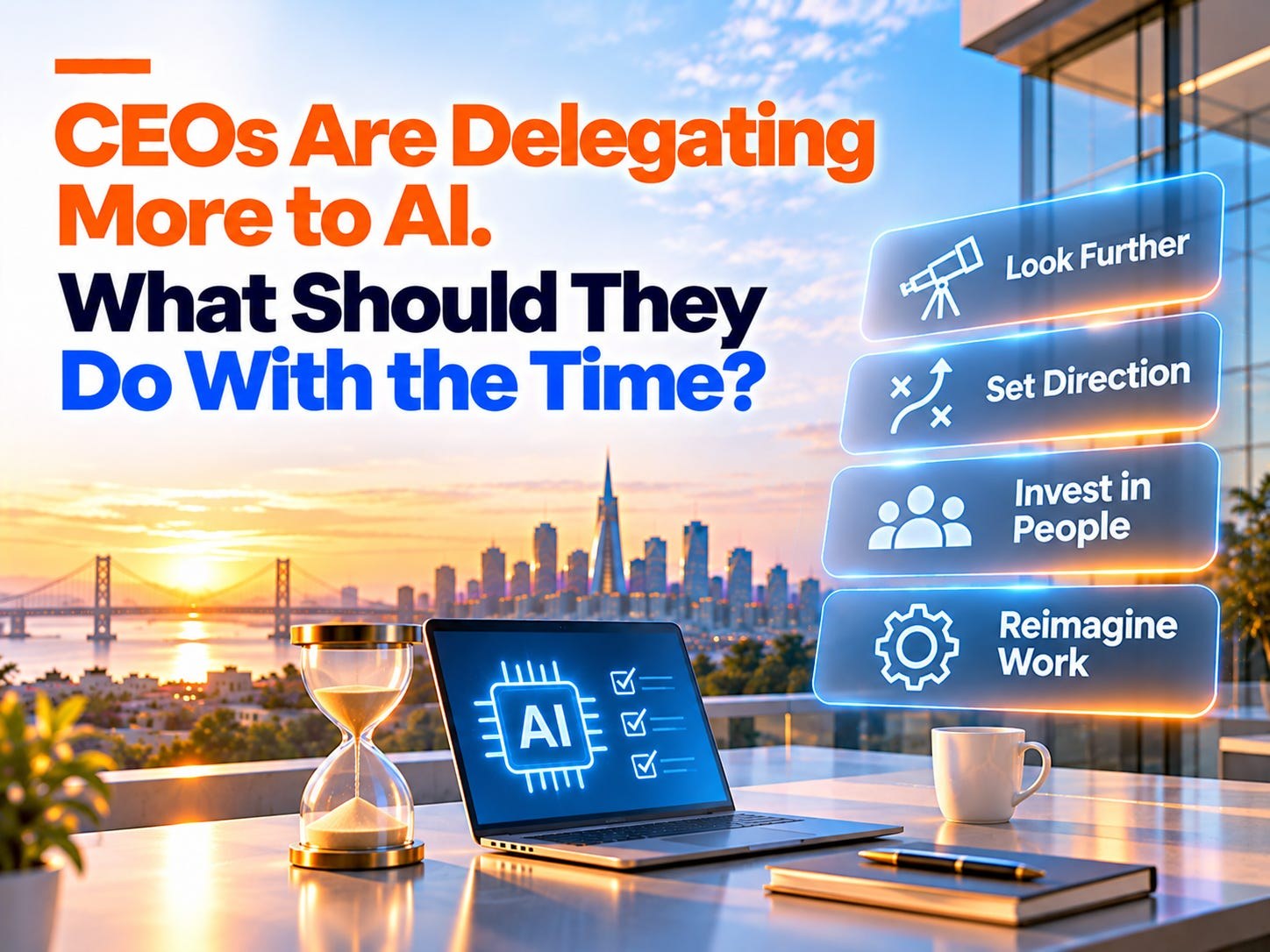
Recent Financial Times reporting describes CEOs using AI for research, meeting preparation, board materials and other information-heavy work — from custom AI assistants to internal systems that make company knowledge easier to find. Some report real reductions in routine preparation.
The operating agenda I described at the top of this issue is a small version of the same shift.
What happens to the saved time isn’t predetermined. An executive who gets back several hours a week could spend them with customers, on strategic alternatives, or developing future leaders. Or could fill them with more meetings and more reports.
There’s a second risk. When analysis is cheap to produce, executives receive more of it than they can evaluate. The constraint moves from producing information to deciding what deserves attention.
AI can help leaders prepare for hard decisions: summarizing competing arguments, finding gaps in an analysis, stress-testing a plan. It can’t take responsibility for the outcome. The FT reporting makes the same point: trust, relationships and judgment stay with the leader.
A recent McKinsey article goes a step further, examining how AI could capture the reasoning behind experienced leaders’ decisions and make it available across the organization. Documented decision principles can’t replace experience, but they could spread judgment beyond the people at the top.
Why it matters
Measure AI’s value for executives by what leaders do differently, not by hours saved. Decide explicitly where the new capacity goes — customers, talent, strategic uncertainty, scrutiny of major investments — or it will fill up with more activity.
Sources: Financial Times reporting on CEOs’ use of AI, October 2026; McKinsey, Turning Executive Judgment into Organizational Intelligence, 2026.
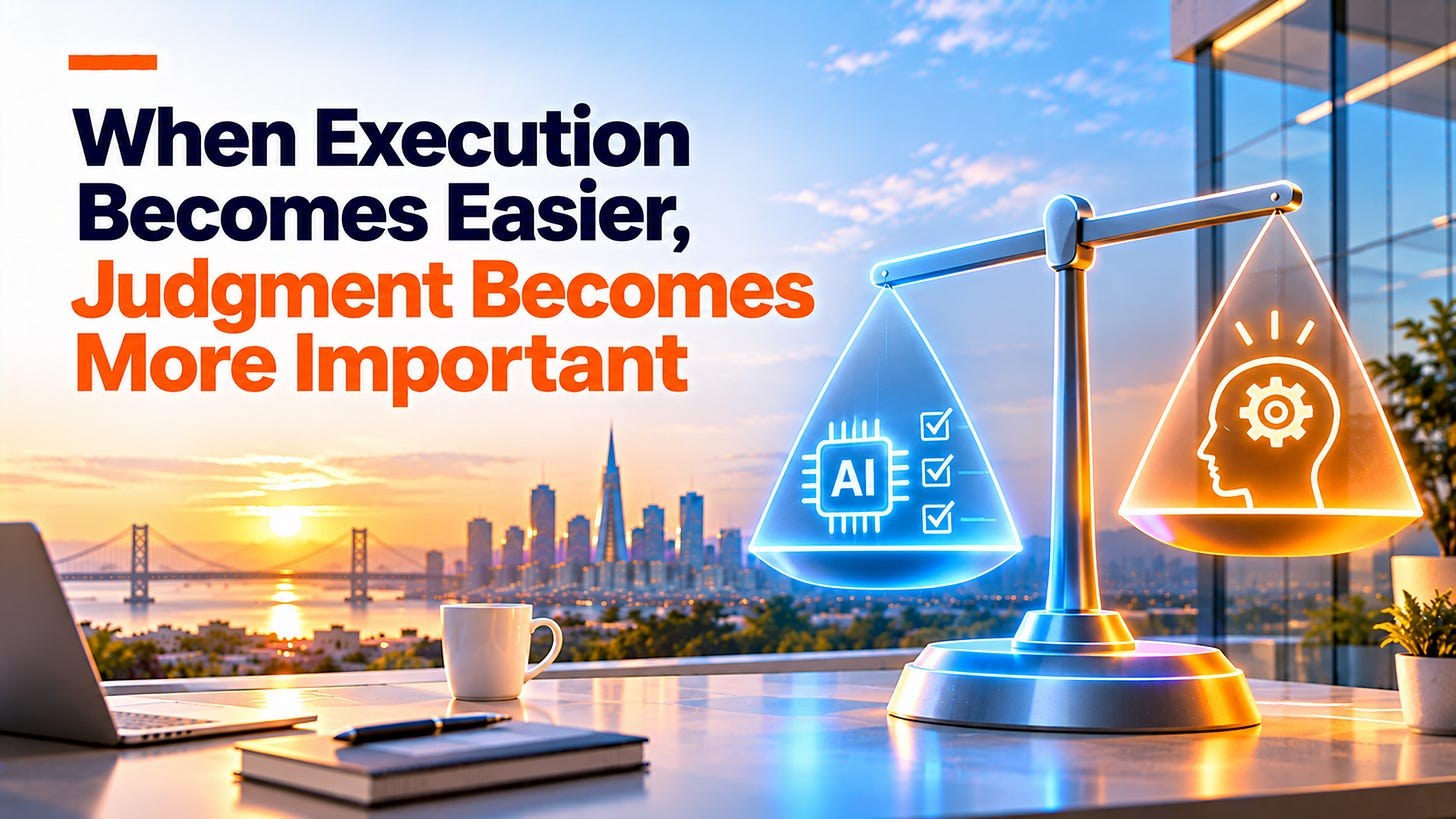
When Execution Becomes Easier, Judgment Becomes More Important
EY shows AI moving from tasks to autonomous operations. Qlik and SAP show that AI needs business context before it can be trusted with consequential decisions. The FT and McKinsey show AI changing how executives spend their time and share their expertise.
Together they point to three responsibilities that become leadership’s core work:
Designing the work: where autonomy creates value, and where people stay in the loop.
Defining the context: the priorities, measures, rules and boundaries AI operates within.
Exercising judgment: challenging recommendations, weighing trade-offs and owning the decision.
Autonomy without context produces wrong outcomes faster. Productivity without priorities produces more activity.
Three questions for your next leadership meeting:
Where are we automating tasks, and where are we redesigning work?
What does our AI need to understand before we trust it to act?
What will our leaders do with the capacity AI creates?
AI may increasingly do the work. Leadership decides which work is worth doing.
From Insight to Action
At Silicon Valley Executive Academy, we help executives understand emerging technologies in the context of strategy, transformation and leadership decisions. The SVEA Tech Trend Radar is a practical starting point: a personalized map of which technologies will reshape your sector, and what each means for your role. And when your team is ready to see these technologies at work, SVEA immersions take you inside the companies building them.
Explore the SVEA Tech Trend Radar →
Innovation Insights is published by Silicon Valley Executive Academy, exploring the intersection of emerging technology, business transformation, and executive leadership.
Originally published in Innovation Insights on Substack.