When Conviction Has to Outrun the Proof

Three leaders made irreversible calls this week without waiting for the data to catch up. Apple handed its CEO seat to the engineer whose own flagship product just got cut. Uber and a wave of employers flattened their org charts on the bet that fewer layers beats more proof. And new research found the people who understand AI best are also the most convinced it’s coming for their jobs — literacy didn’t calm anyone down, it sharpened the fear. The pattern connecting all three: conviction is increasingly running ahead of confirmation, and the leaders managing that gap well look very different from the ones who are just moving fast.
🏗️ Apple’s New CEO Inherited a Confession, Not Just a Company: What John Ternus’s succession — timed three days after 200 Vision Pro layoffs — reveals about managing a failed bet.
🏗️ The Flattening Has Left Tech and Moved Into the Rest of the Economy: Uber just cut 3,300 jobs from a business that isn’t struggling. It’s part of a much bigger pattern.
🧠 The People Who Understand AI Best Are the Most Afraid of It: New research destroys the assumption that AI literacy reduces anxiety — it does the opposite.
Read time: 6 minutes 👇
New Episode Decisions at the Frontier: Leading Through Your Own Innovator's Dilemma
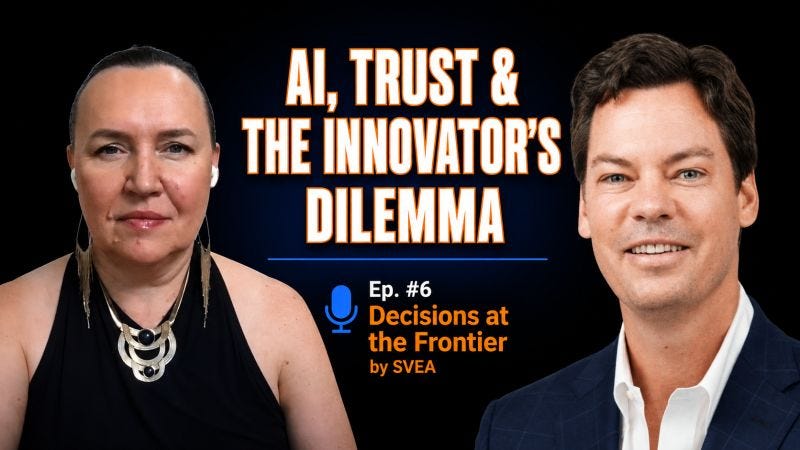
Every leader eventually inherits a version of the same problem: the business model that got you here won’t get you there, and the market won’t wait for you to be sure. Few companies are living that tension more visibly right now than the enterprise automation players moving from robotic process automation into agentic AI.
In this episode, host Victoria Mensch sits down with Christopher Radich, VP and Public Sector CTO at UiPath, for a candid, unscripted look at how UiPath is navigating its shift from “Act One” (RPA) to “Act Two” (AI) — not as a retrospective case study, but in real time.
In this conversation, Victoria and Chris explore:
How UiPath is rethinking its business as generative AI reshapes the automation category
A practical framework for building trust in AI — from chatbots, to human-in-the-loop, to autonomous agents
What actually separates AI pilots that scale from the ones that stall in committee
Three leadership principles for building organizational conviction ahead of the data
Watch the full episode on YouTube.
Apple’s New CEO Inherited a Confession, Not Just a Company
Tim Cook ran Apple for fifteen years, took its market cap from $350 billion to $4 trillion, and never once had to explain a failed hardware bet at this scale. His successor doesn’t have that luxury. John Ternus became Apple’s CEO on September 1, 2026, three days after Bloomberg confirmed roughly 200 layoffs across the Vision Pro, Siri, and gaming teams — the same product Ternus himself engineered.
Apple announced the succession back in April, giving the company a rare five-month runway to manage the story on its own terms. That is not an accident. Cook is stepping into an executive chairman role built around policy and diplomacy, the parts of the job that have gotten harder, not easier, since 2011. Ternus inherits engineering command at the exact moment Apple’s most expensive new product launch in a decade — Vision Pro, unveiled in 2025 — has failed to catch on with buyers.
The company’s own language matters here: Apple confirmed it would “create new roles” even as it cut existing ones, the standard framing for a strategic retreat rather than a cost-cutting panic. Putting a hardware engineer in charge, rather than a services or operations executive, is Apple’s clearest signal yet about where it thinks its actual problem lives — not in retail or supply chain, but in product conviction.
Why it matters: Succession plans are usually built to preserve continuity. This one was built to absorb a failure without a crisis narrative attaching to either the outgoing or incoming CEO. If your own succession timeline does not give your next leader room to inherit bad news on their own terms, you are gambling that nothing breaks during the handover.
The Flattening Has Left Tech and Moved Into the Rest of the Economy

Forty-one percent of professionals say their company cut management layers in the past year, according to Korn Ferry’s global survey of 15,000 workers. Uber just gave that statistic its sharpest recent proof point: on September 2, CEO Dara Khosrowshahi cut roughly 3,300 corporate jobs — 10% of the workforce — from a company that is profitable and has nearly tripled revenue over five years.
Khosrowshahi was explicit that the cuts were not about AI or financial distress. They were about layers. Uber reduced the number of employees sitting seven or more reporting levels below the CEO by 20%, cut micro-teams with only one or two direct reports by nearly half, and capped fully remote roles at roughly 1% of staff. The logic: five years of rapid growth left the company with more coordination and more fragmented ownership than the business now needs.
Uber is not alone. Coinbase restructured to five layers below its CEO earlier this year, explicitly favoring “player-coaches” over pure managers. Citigroup has cut its structure from thirteen layers to eight. What began as a tech-sector story about AI replacing coordination work has become a broader executive playbook, adopted by companies with no AI-driven cost pressure at all.
Why it matters: Khosrowshahi cut from strength, not weakness — a much harder sell to your own organization than cutting from crisis. If your best people read a healthy P&L as proof that structural change is not urgent, you have already lost the argument he is making to his.
The People Who Understand AI Best Are the Most Afraid of It

The comforting theory has always been that AI anxiety comes from not understanding the technology — that better literacy would calm people down. TU Darmstadt’s newest AI Monitor, a representative survey of more than 2,000 people conducted with YouGov, found the opposite. Among respondents with very strong AI knowledge, 43% expect AI could soon take over their own job. That share drops sharply as AI literacy declines.
“Many debates are based on the assumption that concerns are primarily the result of a lack of information,” said Peter Buxmann, the project lead. “This does not appear to be the case: those who understand AI best are also the most aware of its disruptive potential.” The study also found the real driver is not industry — it is whether a person’s output can be digitized. Lawyers, developers, and social media professionals worry more than tradespeople or nurses, regardless of sector.
Only 15% of respondents had received any formal AI training, despite the EU AI Act’s literacy obligations having applied for eighteen months. Buxmann’s own conclusion is pointed: reassurance is the wrong tool here, because job loss costs people more than income — it costs social connection and a sense of purpose.
Why it matters: If your highest-skilled, most AI-fluent people are also your most anxious, “just train them on the tools” will not fix morale — it may accelerate it. Leaders need a genuine answer to what happens to displaced expertise, not just a rollout plan for the software.

Three different stories, one uncomfortable thread: judgment is outrunning proof everywhere you look. Apple bet on an engineer before Vision Pro’s failure was fully priced in. Uber and a growing list of employers are flattening structures before the productivity case is settled. And the workers who best understand what AI can do are the ones least willing to wait and see what it does to them. None of this is inherently reckless — conviction ahead of data is how markets move at all. But it does mean the leaders who win this stretch will be the ones who can tell the difference between a calculated bet and a hopeful one, in real time, without the benefit of hindsight. The honest question for any executive right now is: when you make that call, what are you drawing on? A briefing deck, or a conversation with someone who’s actually in it?
At SVEA, we believe that gap — between informed and embedded — is where the real leadership advantage lives. And it’s the gap we’re built to close.